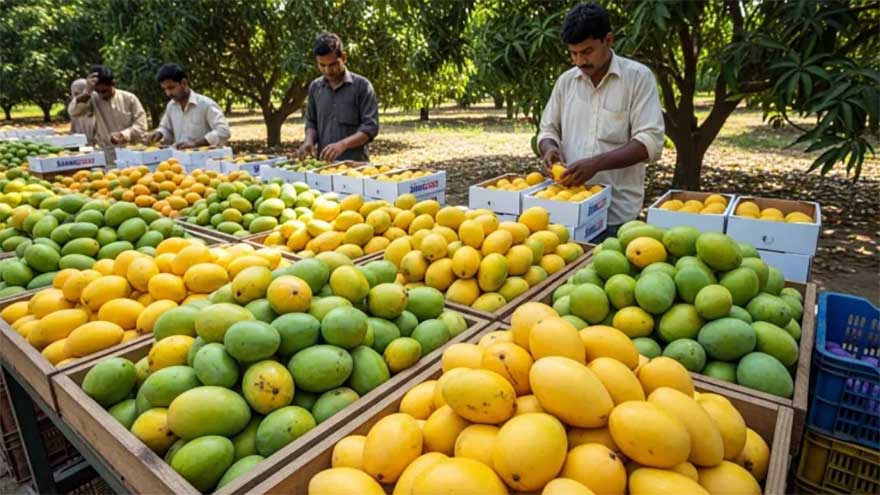
Summary The mango industry also sustains thousands of livelihoods, supporting orchard owners, farm labourers, seasonal pickers, transporters and online sellers
MULTAN (APP) - South Punjab, particularly the districts of Multan, Rahim Yar Khan, Muzaffargarh and Khanewal, is widely regarded as the hub of the country’s mango production, producing some of the world’s finest varieties known for their distinctive sweetness, aroma and texture.
These mangoes are not only a source of national pride but also contribute significantly to Pakistan’s export economy by earning valuable foreign exchange each year.
The mango industry also sustains thousands of livelihoods, supporting orchard owners, farm labourers, seasonal pickers, transporters and online sellers.
During peak season, mango gifting becomes both a cultural tradition and a commercial activity, further boosting trade and creating income opportunities for fruit merchants and digital entrepreneurs.
However, growers have expressed serious concerns over potential violations of the Indus Waters Treaty. Under the World Bank-brokered agreement, Pakistan has rights over the waters of three major rivers.
Farmers fear that upstream water control measures, including dam construction and flow regulation by India, could reduce downstream water availability, directly affecting agriculture in South Punjab.
Mango orchards, which require consistent and adequate irrigation, are particularly vulnerable. Any disruption in water supply may lead to lower yields, reduced fruit quality and long-term damage to trees that take years to mature.
Prominent orchard owner Shahid Hameed Bhutta voiced concern over the situation, saying that the region has produced world-class mangoes for generations and any disruption in water supply could harm both production and the global reputation of Pakistani mangoes. He urged international institutions to take notice of the issue.
Another grower, Malik Arif Kalroo, highlighted the broader economic impact, stating that the mango industry supports thousands of families, from labourers to traders and exporters, and any reduction in water flow would directly affect livelihoods across the region.
Malik Umar Hayat from Nawabpur also warned of long-term risks, stressing that water is the backbone of agriculture in South Punjab and that unresolved issues could impact food security and economic stability.
Growers emphasized that adherence to international agreements such as the Indus Waters Treaty is essential for maintaining regional balance.
The treaty, long seen as a successful model of water-sharing, is now facing renewed scrutiny amid rising tensions.
They warned that failure to take timely measures could have far-reaching consequences. A decline in mango production would not only impact the national economy but also deprive global consumers of a fruit closely associated with South Punjab’s cultural identity.
For centuries, mangoes from Multan and surrounding areas have symbolized heritage, flavour and prosperity.
Growers cautioned that this legacy now stands at a critical juncture, dependent on both natural resources and responsible adherence to international commitments.