Summary Nasdaq futures were up 1.26% in Asia while S&P 500 futures similarly rose 1.11%
SINGAPORE (Reuters) - Asian shares eased on Tuesday, though U.S. futures rose after President Donald Trump delayed his threatened 50% duties on European Union shipments, while the dollar was headed for a fifth straight monthly loss.
In Japan, yields on super-long government bonds fell early in the session, retreating from their all-time highs in the wake of last week's heavy selloff in the bonds.
Markets in the U.S. were closed on Monday for a holiday, making for thin overnight trading conditions and leaving investors latching on to lingering optimism from Trump's U-turn on his threat to impose 50% tariffs on imports from the EU next month, restoring a July 9 deadline.
Nasdaq futures were up 1.26% in Asia while S&P 500 futures similarly rose 1.11%. FTSE futures advanced 0.94%. UK markets were also closed on Monday.
"It was a better night for risk assets, following Trump deferring (EU tariffs) back to July 9," said Tony Sycamore, a market analyst at IG.
"What I think probably is now the main driver for this week is we've got the month-end rebalancing flows, which should start to kick in anytime soon... Nvidia's earnings report again is going to be front and centre in terms of what's going on there."
Results from Nvidia (NVDA.O) are due on Wednesday, where the AI darling is expected to report a 65.9% jump in first-quarter revenue.
Elsewhere, MSCI's broadest index of Asia-Pacific shares outside Japan (.MIAPJ0000PUS) was down 0.17%, while Japan's Nikkei (.N225) similarly fell 0.15%.
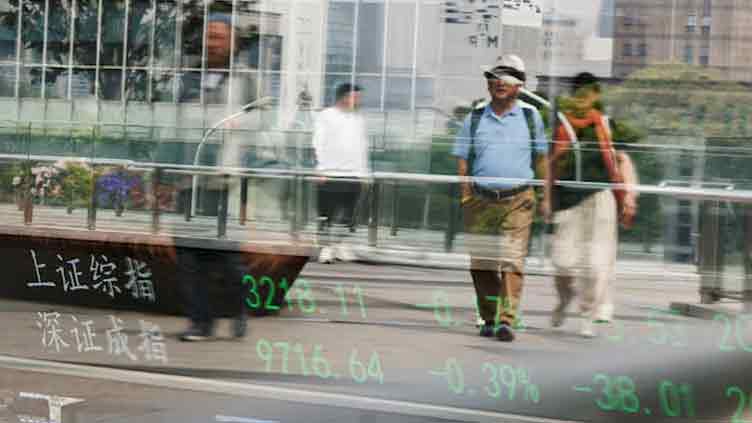
China's CSI300 blue-chip index (.CSI300) edged 0.06% lower while the Shanghai Composite Index (.SSEC) was little changed. Hong Kong's Hang Seng Index (.HSI) dipped 0.1%.
Focus for investors this week will also be on speeches from a slew of Federal Reserve policymakers and Friday's U.S. core PCE price index, for clues on the outlook for U.S. rates.
A two-day annual conference hosted by the Bank of Japan (BOJ) and its affiliated think tank kicked off on Tuesday, with this year's gathering of global central bankers in Tokyo set to focus on flagging economic growth and sticky inflation.