Summary Abbas Araqchi accused UAE of direct involvement in military operations against Iran, in a rare moment when Iranian and Emirati officials have been in the same room
NEW DELHI (Reuters) - Iran’s foreign minister urged BRICS nations on Thursday to condemn what he called violations of international law by the United States and Israel, as diplomats from emerging economies met for talks in Delhi in the shadow of war in the Middle East.
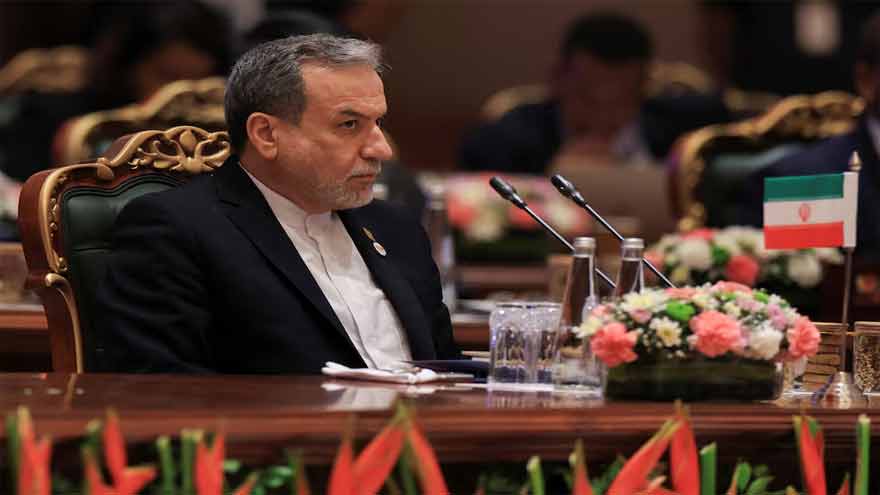
Foreign Minister Abbas Araqchi accused US ally the United Arab Emirates of direct involvement in military operations against Iran, in a rare moment when Iranian and Emirati officials have been in the same room since the US-Israeli war against Iran began on February 28.
Araqchi said Iran was a "victim of illegal expansionism and warmongering". He asked the BRICS+ grouping - comprising Brazil, Russia, India, China, South Africa, Egypt, Ethiopia, Indonesia, Iran and the UAE - to resist "Western hegemony and the sense of impunity that the US believes it is entitled to".
"Iran therefore calls upon BRICS member states and all responsible members of the international community to explicitly condemn violations of international law by the United States and Israel," he said.
Later, he told the gathering that the UAE was "directly involved in the aggression against my country", the Iranian semi-official Mehr news agency reported. The UAE was represented by its Deputy Foreign Minister Khalifa Shaheen Al Marar.
In response to the US and Israeli attacks on Iran, Tehran launched strikes on Gulf States including the UAE.
Their differences could make it difficult for BRICS, which operates by consensus, to agree on a joint statement.
It was not immediately clear how or whether the UAE and other nations attending the BRICS+ meeting had responded to Araqchi's remarks.
DIVIDED PRIORITIES
India, whose partnership with the UAE is deepening, is the BRICS chair for 2026 and is one of the parties most affected by Iran's effective closure of the Strait of Hormuz since the war.
The waterway usually handles about a fifth of global oil shipments, and its blockade has triggered one of the biggest supply disruptions in recent history.
India, the world's third-biggest oil importer and a big user of the strait, has suffered big supply disruptions and lost sailors in attacks on ships in the Gulf.
Although a ceasefire is in place, sporadic attacks have continued.
On Wednesday, an Indian-flagged vessel travelling from Somalia to the UAE and carrying cargo of live livestock sank in Omani waters after a fire on board, though all 14 crew members were rescued by the Omani Coast Guard.
India did not specify the nature of the attack or who was behind it, but British maritime risk management group Vanguard said it involved an explosion believed to have been caused by a drone or missile strike.
"Continuing tensions, risks to maritime traffic, and disruptions to energy infrastructure highlight the fragility of the situation," Indian Foreign Minister Subrahmanyam Jaishankar said. "Safe and unimpeded maritime flows through international waterways, including the Strait of Hormuz and Red Sea, remain vital for global economic well-being."
Without naming any sides, he also noted the "increasing resort to unilateral coercive measures and sanctions inconsistent with international law and the UN Charter".
"Such measures disproportionately affect developing countries," he said. "These unjustifiable measures cannot substitute dialogue, nor can pressure replace diplomacy."
In a visit to Beijing coinciding with the BRICS meeting, US President Donald Trump discussed the Iran war with China's President Xi Jinping, and a White House official said they agreed that the strait should be open, and that Tehran should never obtain nuclear weapons.