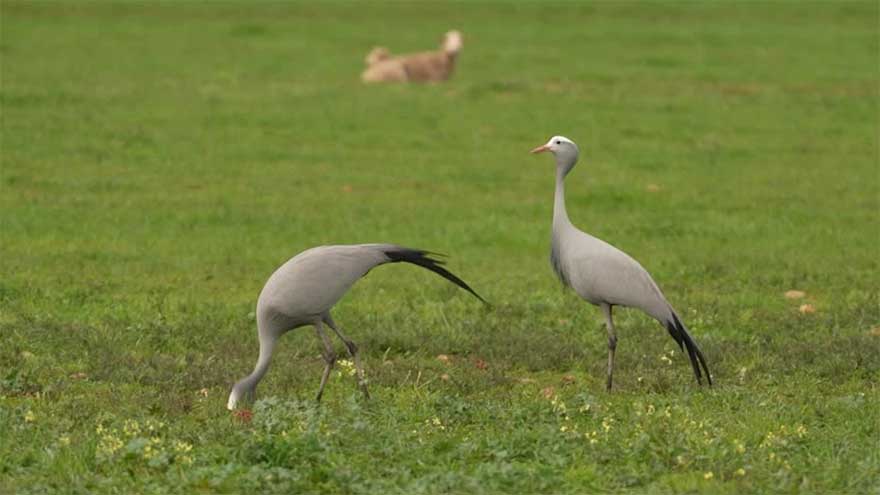
Summary The elegant birds have just been uplisted from near threatened to vulnerable by the IUCN's Red List
OVERBERG (Reuters) – South Africa’s national bird, the blue crane, is now at greater risk of extinction in the wild.
The elegant birds, often seen feeding in farmlands, have just been uplisted from near threatened to vulnerable by the International Union for Conservation of Nature (IUCN)'s Red List.
In the Overberg region of the Western Cape, once a stronghold for the species, populations have dropped by 44% between 2011 and 2025, according to the Coordinated Avifaunal Roadcounts (CAR ), a long running citizen science project.
Farmer Mick D’Alton has seen the shift firsthand.
"The Red Data List has upgraded the Blue Crane from near threatened to vulnerable, and that’s brought renewed interest into the area ... and into why this is happening" he told Reuters.
Blue cranes breed and nest in open farmlands but intensified agricultural practices are putting them under pressure.
"The cropping intensity, crop types, turnover all these are now negatively affecting how these birds breed and raise their chicks" he added.
The birds live almost entirely outside protected areas depending on working farmlands for food and breeding space. Conservationists say partnership with farmers is now more critical than ever.
Collisions with power lines are another growing threat to the species.
Dr Christie Craig from the Endangered Wildlife Trust (EWT) investigates the site of a recent fatal impact.
“This is a line we know is a problem. It’s unmarked in places and a young blue crane has collided with it. Sadly, they usually die on impact” she said.
Conservationists are urging utility companies to install diverters to prevent deaths. Craig says the birds are increasingly becoming unintended casualties of a changing landscape, including climate shifts, fencing, poisoning and infrastructure.
"The poisoning issue is very much an issue of conflict between animals and farming production. So, to deal with the poisoning issue, we need to find ways to deal with crop damage that are more environmentally friendly, and getting awareness out, and obviously having a presence on the ground, so that people don't think that they'll get away with poisoning," Craig told Reuters.
All these pressures and increased wildlife and human conflict are pushing the birds into decline.
“We need to stop the decline, stabilize populations and if possible, help them increase. If not, we’ll see a dramatic crash in the next 20 to 30 years” Craig said.
From a conservation success story to a species under renewed threat. The fate of South Africa’s blue crane may now rely on urgent, coordinated efforts to survive the decades ahead. A multi-stakeholder plan led by the EWT is underway to mitigate power line risks, reduce agricultural threats, and protect the remaining natural habitats.