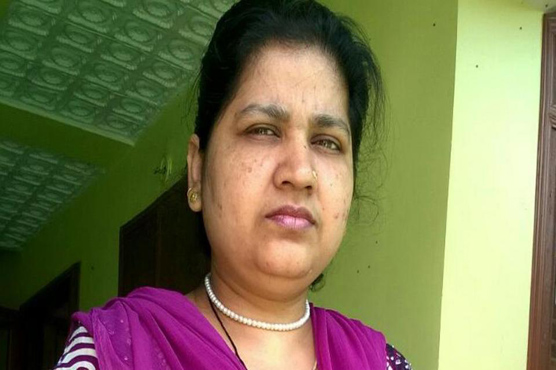
Summary Shayara Bano, one of the first women who petitioned against instant divorce. Photo: Hindustan Times
(Web Desk) - “I welcome and support the judgment. This is a historic day for Muslim women,” 36-year-old Shayara Bano, one of the first petitioners to challenge the custom of ‘triple talaq’ in India, stated after a historic verdict that has ruled the practice unconstitutional.
The Supreme Court of India gave its verdict on Tuesday on a controversial case of “triple talaq” ruling out the divorce custom prevalent in Muslims in India.
Shayara Bano reacts soon after the SC verdict on #tripletalaq @htTweets pic.twitter.com/8C1fM6juM5
— Moushumi Das Gupta (@dgupta_moushumi) August 22, 2017
According to the Hindustan Times, five Supreme Court judges from different faiths gave their decision by 2-3 ruling out instant divorce. Seven Indian Muslim women had petitioned in the SC against the practice along with a few human rights activists.
Bano was divorced in an informal manner, her husband Rizwan Ahmad sent her a letter with “talaq” written thrice. The letter was sent to her on October 15, 2015 when she was visiting her parents’ house. She filed for a petition in the Supreme Court on February 23, 2016.
“Understand the condition of women in Muslim society, accept the judgment and bring a law on it as soon as possible,” she said.
Rizwan Ahmed, after divorcing her, forcefully took away her two children- Irfan (13) and Muskan (11). Bano had a nervous breakdown and had to be treated for depression.
She in her previous interviews stated that she was constantly tormented for dowry since 2002. Despite the torments, and the ill-fated letter she received in the end, Bano went to seek council from a local cleric. But he told her that the talaq was valid.
The SC verdict has been welcomed by many prominent Indian politicians, Muslim clerics and gender rights activists.
The Supreme Court s decision to declare #TripleTalaq as unconstitutional is a historic milestone in Muslim women s rights movement in India.
— Tufail Ahmad (@tufailelif) August 22, 2017
Maulana Yasoob Abbas, a Shia cleric stated after the verdict, “Shia Personal Law Board has been fighting against triple talaq since 2007, we welcome this verdict. It is a great first step.”
Naseem Akhtar, Jaipur convener of Bharatiya Muslim Mahila Andolan, says: “It’s a good and balanced decision. Now we hope and expect the government to make a law against triple talaq the soonest.”
Aafreen Rehman, affected by triple talaq, from Jaipur says: “I am happy with the court’s decision. It’s a beginning towards the abolition of triple talaq in the country. A law against triple talaq is what we wanted and the court has directed the government to do the same. And the court has in a way banned it until the law is made. The cruelty that was happening against women in the name of triple talaq, wherein they were thrown out of the house like a pair of shoes, will now end.”
"Muslim women in India have suffered for the last 70 years. It s a historic day for us, but it doesn t end here," Zakia Soman, a women s rights activist, from Bharatiya Muslim Mahila Andolan, one of the organisations who contested the practice stated.
Pakistan and Bangladesh have banned triple talaq, but the custom is flourishing in India, stated by the Indian activists.
In recent years, Muslim men in India have been divorcing their wives through letters, telephone and increasingly by text messages, WhatsApp and Skype. The cases emerged after the women petitioned against the custom in courts.
India has no uniform set of laws on marriage and divorce that applies to every citizen.