Summary Global poverty rates could be more than halved if all adults completed secondary school
(Web Desk) - If all adults completed secondary education, 420 million could be lifted out of poverty globally. This would reduce the total number of poor people by more than half globally and by almost two-thirds in sub-Saharan Africa and South Asia.
This was reported in a new UNESCO policy paper that interlinked global poverty rate to persistently high out-of-school rates in many countries. The study goes on to show global poverty rate could be more than halved if all adults completed secondary school. The new analysis on education’s impact on poverty by UNESCO’s Global Education Monitoring (GEM) Report team is based on the average effects of education on growth and poverty reduction in developing countries from 1965 to 2010.
Despite education’s potential, new UIS data show that there has been virtually no progress in reducing out-of-school rates in recent years. Globally, 9% of all children of primary school age are still denied their right to education, with rates reaching 16% and 37% for youth of lower and upper secondary ages, respectively. In total, 264 million children, adolescents and youth were out of school in 2015.
.jpg)
Sub-Saharan Africa remains the region with the highest out-of-school rates for all age groups: more than half (57%) of all youth between the ages of 15 and 17 are not in school, as are more than one-third (36%) of adolescents between 12 and 14 years and one-fifth (21%) of children between the ages of about 6 and 11.
Six countries are home to more than one-third of all out-of-school children of primary age: Ethiopia, India, Indonesia, Nigeria, Pakistan and Sudan.
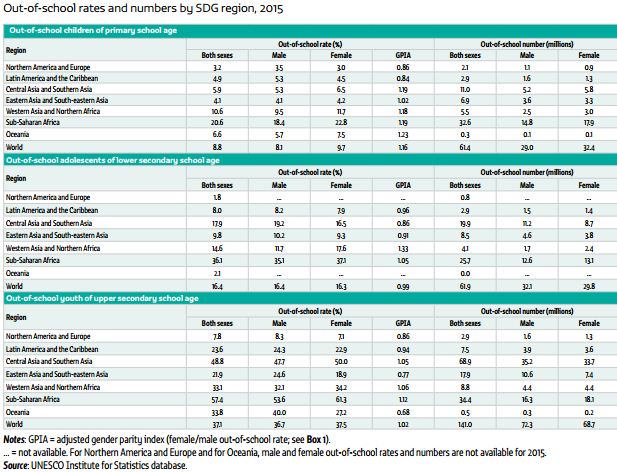
Of the 61 million children of primary school age currently out of school, 17 million will never to set foot in a classroom if current trends continue. This affects one in three children out of school in sub-Saharan Africa, Western Asia and Northern Africa, and more than one in four of those in Central Asia and Southern Asia.
Girls in poor countries continue to face particularly steep barriers to education. According to UIS data, in low-income countries, more than 11 million girls of primary age are out of school, compared to almost 9 million boys. The good news is that the girls who do manage to start school tend to complete the primary cycle and pursue their studies at the secondary level.
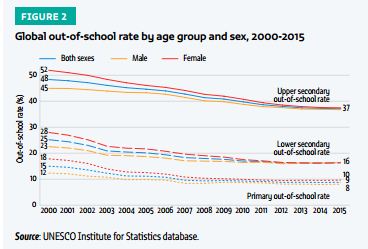
Education must reach the poorest in order to maximize its benefits and reduce income inequality. Yet the GEM Report shows that children from the poorest 20% of families are eight times as likely to be out of school as children from the richest 20% in lower-middle-income countries. Those of primary and secondary school age in the poorest countries are nine times as likely to be out of school as those in the richest countries.
While calling on countries to improve the quality of education, the paper stresses the need to reduce the direct and indirect costs of education for families. New UIS data confirm that many households still have to bear expenses relating to education, totaling $87 per child for primary education in Ghana, $151 per child in Côte d’Ivoire and $680 in El Salvador.