Summary Taiwanese president Ma Ying-jeou's is meeting with China's leader Xi Jinping on Saturday.
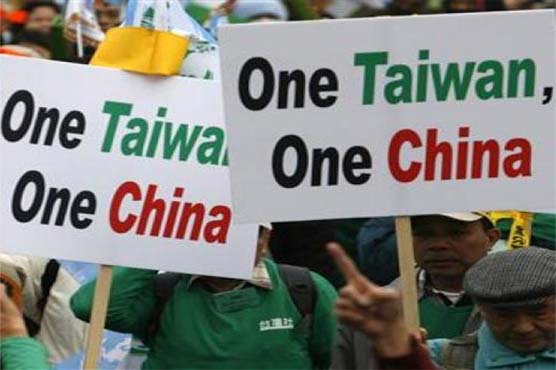
TAIPEI (AFP) - In Taiwan s decades-long debate over independence or reunification with mainland China, the colours blue and green symbolise a rift that polarises friends and families and has been deepened by this weekend s historic summit.
Taiwanese president Ma Ying-jeou s meeting with China s leader Xi Jinping in Singapore on Saturday has unleashed a visceral response on the island, a cold war outpost which has long sheltered under a United States pledge of protection.
But as the island wearies of the seemingly irreconcilable split over its identity and future, exemplified by the colour-coded political parties, some are seeking to breach the divide.
The summit could be a turning point for Taiwan, a self-ruling democracy which split from China in 1949 following a civil war, and which Beijing views as a renegade province awaiting reunification -- by force if necessary.
The blue camp favours closer ties with China, with the staunchest "dark blues" supporting full unification.
The greens strongly reject any "one China" principle, viewing Taiwan as an entirely separate entity. "Dark greens" call for formal independence from China -- a move that would risk an armed response.
Ma s Beijing-friendly Kuomintang (KMT) is the main blue party, while the opposition Beijing-sceptic Democratic Progressive Party (DPP) represents the greens.
"Taiwan traditionally has been split between the KMT and DPP, or the unification and independence they each represent," says Wang Yeh-lih, a political science professor at National Taiwan University.
"The blue supporters will back the Ma-Xi meeting, and the greens will of course oppose it. Taiwan has never had a high degree of consensus on this."
The blue, taken from the KMT banner of a white sun against a blue sky, is associated with the party s urban strongholds in the north, while green evokes the DPP s grassroot rural support, particularly in the island s south.
The announcement of Saturday s talks provoked strong responses from from political leaders, academics and the general public, with the blue camp saying it was long overdue and the greens accusing Ma of selling out Taiwan.
While citizens have become used to the split, some fear the enduring impact across an island that is heading to presidential elections in January as Ma bows out.
"My family is open-minded, but the problem has affected relationships between some of my friends. They argue until they are red in the face, defending their political ideas or their favourite parties," says Jesmine Su, a 30-year-old office worker from the southern city of Tainan.
"The phenomenon is bad for Taiwan... it has led people not to look at issues in a rational manner, from individuals and families to different political parties," she said.
A third way?
Ma has overseen a dramatic rapprochement with China since he came to power in 2008, yielding a tourism boom, the opening of flight routes, and more than 20 trade agreements.
But there is scepticism from voters who believe that only big business has benefited from the pacts, while the Taiwanese economy remains in the doldrums and salaries are static.
There are also fears that closer ties will risk Taiwan s sovereignty and security as Beijing tries to impose control, concerns that have seen public support for the president and his party plummet.
But while Ma s leadership has stoked divisions, there are also those who seek a path beyond the green-blue polarisation, and independent candidates with a fresh approach have benefited at a local level.
"I m part of the population that doesn t care about green or blue. I care about the present, the reality, who can really make Taiwan better," said Hu Chih-cheng, 48, a building manager in Taipei who is among those embracing the new credo.
With the economy flagging, livelihood issues have become central to voter sentiment, for some overriding their traditional leanings.
Some analysts say the line between the camps is far more nuanced and flexible than it might initially appear as pragmatism weighs on ideology.
"There are of course many people who are diehard greens or diehard blues, but a much larger majority of voters base their support on the performance and policies of the parties," says Jonathan Sullivan from the University of Nottingham s School of Contemporary Chinese Studies.
"If the blue-green cleavage was absolute, we wouldn t see the kind of fluidity and volatility in election results in Taiwan," he said.
"Remember that after 2008 the DPP was supposedly finished, while the KMT rose to ascendancy. Now the opposite is happening."