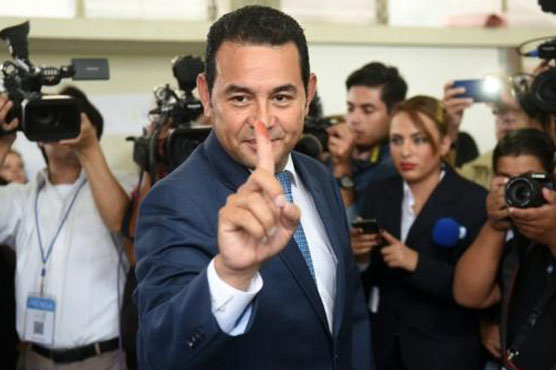
Summary With 81.5% of ballots counted, Morales had 25.8%, against 18.6% for lawyer Manuel Baldizon
GUATEMALA CITY (AFP) - A comedian whose shtick was playing a simpleton cowboy who becomes president emerged Monday as the man to beat in Guatemala s presidential race amid disgust over a corruption scandal that felled the outgoing incumbent.
Political novice Jimmy Morales led the count after Sunday s presidential vote and appeared headed for a runoff against whichever of two more traditional rivals emerges less scathed from the scandal s fallout.
With 81.5 percent of the ballots counted, Morales had 25.8 percent, against 18.6 percent for lawyer Manuel Baldizon and 17.9 percent for former first lady Sandra Torres.
With no candidate near the 50 percent necessary to avoid a second round, the election is bound for an October 25 runoff between Morales and either fellow conservative Baldizon or social democrat Torres.
Morales, 46, began the campaign as a long-shot.
But the actor and TV host surged to a last-minute lead as Guatemalans punished the political elite for a swirl of scandals, including the one that forced president Otto Perez to resign and landed him in jail.
Morales rose to fame playing the role of "Neto," a hayseed who accidentally winds up being president.
He ran a light-hearted campaign in his first foray into national politics, cracking jokes at rallies but giving few concrete details on policy plans.
"For 20 years I ve made you laugh. I promise that if I become president I won t make you cry," he told voters.
Thousands of Guatemalans had taken to the streets to protest corruption since the scandal broke in April, on a scale never before seen in the impoverished Central American nation.
"The people are tired of more of the same," Morales told reporters after learning of his lead.
Political analyst Cecil de Leon said the comedian had emerged as "a political phenomenon, without a past in political parties or public positions."
- Voting in mourning -
The protest movement had been split over whether to take part in the polls.
On Twitter, the hashtag "voting in mourning" was trending in Guatemala on Sunday -- a slogan of reluctant participation.
Election officials put turnout at around 70 percent, similar to the last general elections in 2011.
After a tumultuous campaign, the race wound up with a drama-packed homestretch.
Perez submitted his resignation just before midnight Wednesday, after Congress stripped him of his immunity and a judge issued a warrant for his arrest.
By Thursday evening, the conservative leader was in jail, and Morales had eclipsed long-time frontrunner Baldizon in the final opinion poll.
New President Alejandro Maldonado, a former Constitutional Court judge who was hastily sworn in Thursday, will serve until an elected successor is inaugurated on January 14.
Prosecutors and investigators from a UN commission tasked with fighting high-level graft in Guatemala accuse Perez of orchestrating a scheme that allowed importers to pay bribes to get illegal discounts on their customs duty.
The scheme -- dubbed "La Linea" (the line), for a hotline businesses allegedly called to access a network of corrupt officials -- collected $3.8 million in bribes between May 2014 and April 2015, including $800,000 each to Perez and jailed ex-vice president Roxana Baldetti, prosecutors allege.
A judge will decide Tuesday whether to indict the former president, who denies involvement.
Perez, a retired general who had been in power since 2012, was constitutionally ineligible to stand for reelection.
Voters were also choosing a 158-seat Congress, 338 mayors and 20 delegates to the Central American regional parliament.
Guatemala is still recovering from a 36-year civil war that ended in 1996, and 53.7 percent of the population lives in poverty.
It also suffers under the scourge of powerful street gangs blamed for giving it one of the highest murder rates in the world.
Corruption accounts for 50 percent of political parties financing, and some $500 million in state funds goes missing every year, according to estimates by the Central American Institute for Fiscal Studies.