Summary North, South Korea end marathon crisis talks
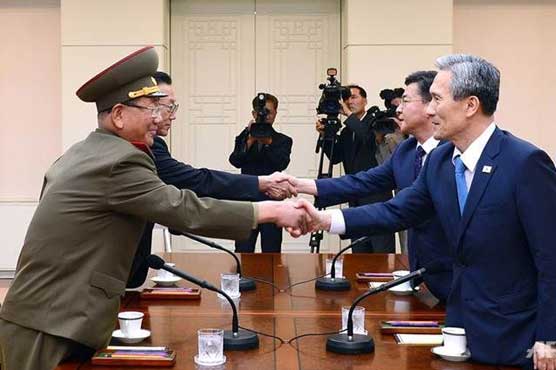
SEOUL (AFP) - North and South Korea on Tuesday wrapped up marathon talks aimed at defusing a crisis that pushed the two rivals to the brink of armed conflict.
North and South Korea wrapped up marathon talks Tuesday with an agreement aimed at defusing a crisis that had pushed the two rivals to the brink of armed conflict.
The South s lead negotiator, National Security Adviser Kim Kwan-Jin, said the North had agreed to a key demand to voice "regret" over recent mine blasts at the border that maimed two South Korean soldiers.
In response, the South conditionally undertook to halt loudspeaker propaganda broadcasts into North Korea.
The two also agreed to work towards a resumption next month of reunions for families separated by the 1950-53 Korean War, Kim told reporters.
The negotiations in the border truce village of Panmunjom had played out against a dangerous military stand-off, which triggered a rare artillery exchange over the border last week and saw North Korean leader Kim Jong-Un order his frontline troops onto a war-footing.
The talks had begun early Saturday evening, shortly after the passing of a North Korean deadline for Seoul to halt its propaganda broadcasts or face military action.
The negotiations were aimed at ending a dangerous military stand-off which triggered a rare artillery exchange over the border last week, after which North Korean leader Kim Jong-Un ordered his frontline troops onto a war-footing.
The talks in the border truce village of Panmunjom had begun early Saturday evening, shortly after the passing of a North Korean deadline for Seoul to halt loudspeaker propaganda broadcasts across the border or face military action.
They were held against a background of continually rising tensions, with South Korea and US fighter jets flying simulated bombing sorties, and North Korea reportedly deploying two thirds of its 70-vessel submarine fleet.
The roots of the crisis lay in landmine blasts on the border earlier this month that maimed two South Korean soldiers.
Accusing Pyongyang of laying the mines, Seoul retaliated by switching on giant banks of loudspeakers, that had lain silent for more than a decade, and blasting high-decibel propaganda messages into North Korea.
The North denied any role in the mine blasts and issued an ultimatum for the South to halt its "psychological warfare" or face attack.
On Monday, South Korean President Park Geun-Hye insisted that the broadcasts would continue unless the North issued a "clear apology" for the landmine incident.
"There will be no retreat in the face of North Korean threats," a combative Park said in televised remarks to a meeting of senior aides.
The crisis had been eyed with mounting concern by neighbouring countries and beyond, with China and Japan calling for restraint and UN Secretary General Ban Ki-moon urging both sides to "redouble" their efforts to reach a compromise.