Summary Both the European Union and the United States gave a cool reception to Netanyahu's upset victory
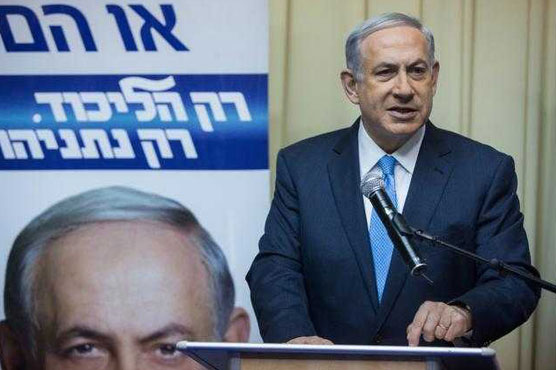
JERUSALEM (AFP) - As Benjamin Netanyahu weighed up options for a new rightwing coalition Thursday, Western governments cranked up the pressure on the Israeli premier over his controversial campaign pledge ruling out a Palestinian state.
Both the European Union and the United States gave a cool reception to Netanyahu s upset victory in Tuesday s election.
They expressed concern that his lurch to the right during the hard-fought campaign could prove an insurmountable obstacle to any resumption of peace talks.
Palestinian president Mahmud Abbas said a two-state solution to the Middle East conflict would be impossible with a new government led by Netanyahu.
In a last-ditch appeal to Israel s far right just hours before polls opened, the incumbent ruled out the establishment of a Palestinian state and pledged to build thousands of new homes for Jewish settlers in annexed Arab east Jerusalem.
While it may have secured him a third consecutive term, it has left him deeply isolated internationally and has done further damage to his already frosty relations with US President Barack Obama.
Washington brokered nine months of negotiations between Netanyahu s last government and the Palestinians that were predicated on a two-state solution and accused the Israeli premier of helping bring about their collapse.
The White House said it continued to see a two-state solution as "the best way" to resolve the Middle East conflict and warned it was reviewing its policy on the diplomatic stalemate between Israel and the Palestinians.
"Based on Prime Minister Netanyahu s comments, the United States will reevaluate our position and the path forward in the situation," it said.
The statement did not elaborate on the options under consideration but speculation swirled about whether the Obama administration might cease using the US veto at the UN Security Council to shield Israel from the Palestinians efforts for statehood.
"Netanyahu s comments don t help his credibility, as he seems to be contradicting his own policy from last year when he was negotiating a two-state solution," Natan Sachs, a fellow in Middle East policy at the Brookings Institution, told AFP.
He said it was likely that the Israeli premier would try to retreat from his campaign remarks somewhat, "though that will not be an easy task to do."
- Abbas demands legitimacy -
============================
The Palestinian leader said that it was clear from Netanyahu s campaign pledges that there was no prospect of a negotiated settlement with him as prime minister.
"Netanyahu s statements against a two-state solution and against a Palestinian state... are proof, if correct, that there is no seriousness in the (future) Israeli government about a political solution," Abbas said.
Abbas said the Palestinians would continue to "demand international legitimacy," in reference to their attempts to achieve statehood through the United Nations and other international bodies.
"It is our right to go to anywhere in the world to achieve international legitimacy," he said.
The Palestinians will formally join the International Criminal Court on April 1 and have vowed to seek action from the very first day for alleged Israeli war crimes during last year s conflict in the Gaza Strip.
EU foreign affairs chief Federica Mogherini telephoned Netanyahu to impress upon him the need to "relaunch" peace negotiations "based on a two-state solution".
"More than ever, bold leadership is required from all to reach a comprehensive, stable and viable settlement," she said in a statement.
Netanyahu s cente-left challenger Isaac Herzog had campaigned on pledge to relaunch peace negotiations with the Palestinians and mend ties with Washington.
Conceding defeat, the Zionist Union leader quickly ruled out any participation in a unity government with Netanyahu, saying going into opposition was "the only realistic option."
Results released by the Central Elections Committee on Thursday confirmed that Netanyahu s Likud party had taken 30 of the 120 seats in parliament to 24 for the Zionist Union.
Rightwing and religious parties -- including the centre-right Kulanu -- took 67 seats to 53 for the centre-left and Arab parties.
The Joint List, which groups the main Arab parties, made a strong showing, becoming the third-largest faction in parliament.
Thursday s results gave them 13 seats, one fewer than previously announced, however.
The extra seat was taken by the leftwing Meretz party, giving it a total of five.