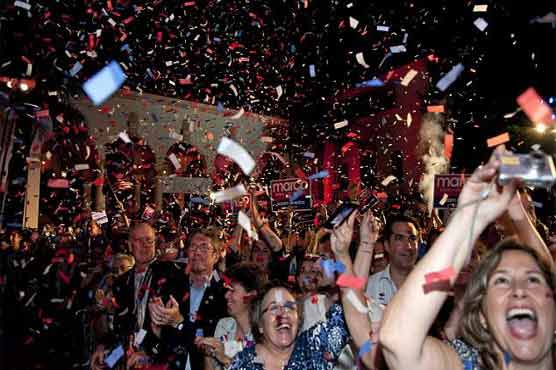
Summary Republicans scored early victories in elections Tuesday as they vied for control of US Senate.
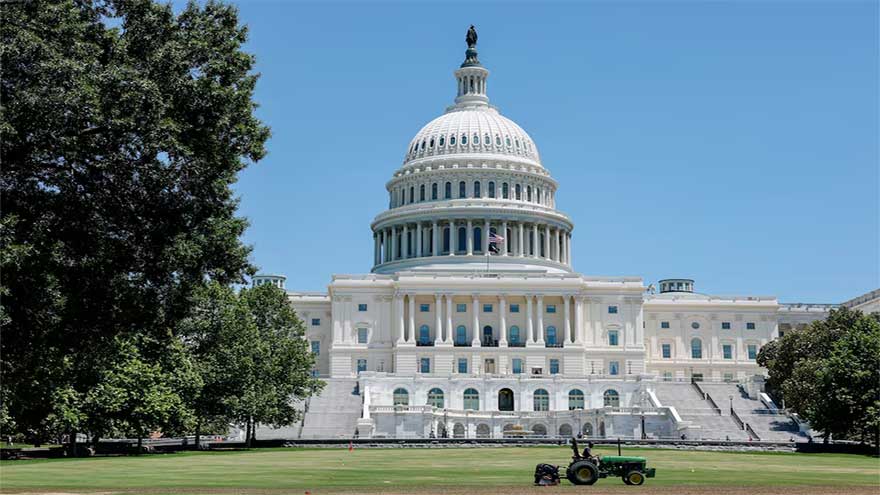
WASHINGTON (AP) - Republicans moved closer to seizing control of the Senate, scoring early victories Tuesday, in elections shaped by deep voter discontent with President Barack Obama.
Within hours of the first polls closing, Republicans won three of the six seats needed to take over the Senate majority:
South Dakota, Arkansas and West Virginia. They were certain to win Montana as well and had solid prospects to capture more Democratic seats. Democrats, meanwhile, had few opportunities to unseat Republicans.
Republicans were also expected to increase their majority in the House of Representatives. If they take the Senate too, that would complicate the final two years of Obama s presidency, potentially deepening the partisan gridlock in Washington.
Among the Republicans re-elected Tuesday was the man who would likely become majority leader if the party captures the Senate: Mitch McConnell of Kentucky. Democrats once had high hopes of defeating him, but he pulled away in the final weeks.
Democrats scored one crucial victory, in New Hampshire, where incumbent Jeanne Shaheen held off a challenge from Scott Brown, a former senator from neighboring Massachusetts.
Who controls the Senate may not be known until well into Wednesday or even days or weeks later. Two races, Georgia and Louisiana, could go to a runoff if no candidate wins a majority. Results from Alaska, a potentially close race, won t start coming in until after 1 a.m. Eastern time (0600 GMT).
Turnout was critical. Fewer Americans vote in so-called midterm races than in presidential races, so parties focus on getting loyalists to the polls, more than swaying centrist, undecided voters.
Republicans were more fired up, united in opposition to a president they see as pushing the government too deeply into American lives. But dissatisfaction goes beyond the party. Americans tend to be disgruntled these days, uneasy with the slow pace of the economic recovery and besieged by troubling news, such as the beheading of Americans by Islamic extremists and worries about Ebola. Opinion polls show Obama s popularity falling and, though he wasn t on the ballot, Republicans made him the focus of their campaign.
"I m just waiting for him to be gone," said Kristi Johnson, a 36-year-old pharmacist from North Carolina.
Exit polls showed most of the Americans voting Tuesday were unhappy or even angry with the Obama administration.
While there was also criticism for Republican congressional leaders, the surveys offered encouragement to Republicans hoping to benefit from voters glum mood.
It was bound to be a difficult election for Democrats. Governing parties historically lose seats in midterm votes and a number of Democrats were defending seats in states that lean Republican. Some were first elected to six-year terms in 2008, riding the wave of excitement over Obama s initial candidacy.
By contrast, Democratic candidates in this year s most competitive Senate races did whatever they could to distance themselves from the president. Obama largely limited his campaigning to candidates in solidly Democratic territory. In a sign of the grim outlook for Democrats, the party had to scramble in the final days to help incumbents who suddenly found themselves in danger.
Overall, at stake Tuesday were 36 of the 100 Senate seats, all 435 House districts and 36 of 50 governors seats. The spending was unprecedented for a non-presidential year. Congressional races alone cost an estimated $4 billion.
Democrats did have some hopes in the gubernatorial races: In Florida, Republican-turned-Democrat Charlie Crist was locked in a tight race with Republican Gov. Rick Scott. In Wisconsin, Republican Gov. Scott Walker faced a strong challenge from Democrat Mary Burke. Both races have implications for the 2016 presidential race: The Florida vote will be closely watched to see how White House contenders might vie for the largest battleground state. And Walker is a potential presidential candidate, though a defeat Tuesday would likely end those ambitions.
In the House, only a few dozen races are truly competitive. The dominant parties in state legislatures tend to carve out congressional districts to maximize the number of seats their parties can win, a process known as gerrymandering.
Still, even with the few competitive races, Republicans could end up with more seats than at any time since 1946, if they manage to pick up 13.
If Republicans take over the Senate, Obama would likely have to contend with McConnell as the leading senator in the chamber. McConnell is a conservative with little charisma, but sharp political skills. He s opposed Obama on health care reform and other issues, but also helped broker bipartisan deals that ended last year s government shutdown and averted a 2011 federal default.
With both chambers in Republican hands, Obama would seem to have little hope for his top legislative priorities, such as raising the minimum wage or overhauling immigration policies. But that s not a huge change, since he s had little success with Congress since Republicans captured the House in 2010.
Republicans would face challenges of their own. Even if they control the Senate, they won t have the 60-vote supermajority that s needed to pass major legislation. And they will face a tougher Senate election in 2016, when Republicans elected in the anti-Obama wave of 2010 will be defending seats in states that lean Democratic.
Also, Republicans could feel pressure to show more leadership, beyond standing in opposition to Obama. That s especially critical as attention shifts to the 2016 president race. Republicans have a wide field of possible candidates, with no clear front-runner. Among the Democrats, former Secretary of State Hillary Rodham Clinton is the clear favorite, though she has not said if she will run.