Summary Israeli public radio confirmed Thursday's meeting was taking place but gave no details.
JERUSALEM (AFP) - Israeli and Palestinian negotiators on Thursday held US-mediated talks to try to revive their crisis-hit peace process, a Palestinian official said, as a report emerged of a possible breakthrough.
Peace talks sponsored by Washington hit a new impasse at the end of March when Israel refused to release a final batch of Palestinian prisoners and the Palestinians retaliated by seeking membership of several international treaties.
US Secretary of State John Kerry, who fought hard to kick-start the talks last July, this week blamed Israel for the latest deadlock as Washington mulled how much more time and effort to put into the faltering negotiations.
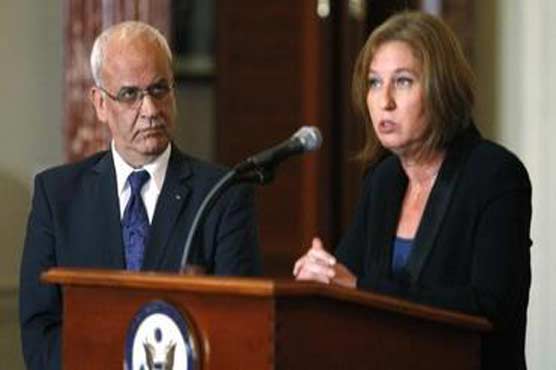
American envoy Martin Indyk presided over Thursday s meeting in Jerusalem between Israel s chief negotiator, Justice Minister Tzipi Livni, and her Palestinian counterpart Saeb Erakat, a Palestinian source close to the talks told AFP.
Also present were Yitzhak Molcho, a confidant of Prime Minister Benjamin Netanyahu, and Palestinian intelligence chief Majed Farah, the source said, on condition of anonymity.
The Palestinians were pushing for the release of a final batch of prisoners, a commitment Israel reneged on at the end of last month in a move which sparked the crisis.
Israeli public radio confirmed Thursday s meeting was taking place but gave no details.
An Israeli official told AFP, also asking not to be named, that "Israel wants to return to talks and overcome the current crisis".
Israeli television later reported that the two sides were on the verge of a deal to extend peace talks beyond their original April 29 deadline.
The deal, which could be finalised within "a few days", would see a final batch of Palestinian prisoners released in return for Washington freeing American-born Israeli spy Jonathan Pollard, Channel 2 television said.
It cited "sources in Washington" as saying that "the parties are to sign an agreement to extend negotiations beyond April 29."
"According to the source, the agreement will include the release of Palestinian prisoners, including Arab-Israelis, in exchange for the release of Jewish American spy Jonathan Pollard," the report said.
In Washington, however, a US official, asking not to be named, told AFP that the "reports are incorrect", without going into details.
The Israelis have repeatedly asked Barack Obama and previous US presidents to release Pollard, who is serving his sentence in North Carolina for passing US secrets on Arab and Pakistani weapons to Israel during the mid-1980s.
Pollard, who was given a life sentence in 1987, is eligible for release from November next year.
- Prisoners and settlements -
When Israel refused to release 26 long-serving Palestinian prisoners, it went back on a pledge it made at the launch of peace talks.
The Palestinians responded by abandoning their own commitment not to seek international recognition until the nine months of talks ended, applying for membership of 15 international treaties.
Kerry on Tuesday blamed Israel for the crisis, saying its April 1 approval of 708 Jewish settlement homes in east Jerusalem derailed plans for the prisoner release.
While he cited intransigence on both sides, Kerry said the delayed release was sabotaged by the settlements move.
"In the afternoon, when they were about to maybe get there, 700 settlement units were announced in Jerusalem and, poof, that was sort of the moment," Kerry told the Senate Foreign Relations Committee.