Summary Khodorkovsky and his business partner Platon were convicted of fraud and tax evasion in 2005.
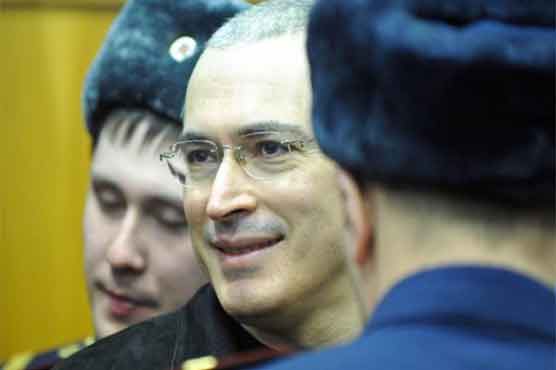
MOSCOW (AFP) - President Vladimir Putin announced Thursday that he will pardon ex-oil tycoon and bitter Kremlin critic Mikhail Khodorkovsky, a move that should see post-Soviet Russia s most famous prisoner freed after more than a decade behind bars.
Putin revealed after his marathon annual news conference that Russia s once richest man had for the first time written a request for a pardon, citing humanitarian circumstances as his mother is ill.
The shock announcement comes after Russian investigators said earlier this month they were probing several more criminal cases against former Yukos oil company chief, who has been in prison since 2003.
Khodorkovsky s legal team and even his mother said they had no information that the former oil tycoon had asked for a pardon but Putin s spokesman told AFP the request had been personally signed by him.
"I think given the circumstances we can take the decision and very soon the decree to pardon him will be signed," Putin said in comments broadcast by state television.
His mother is ill
Putin said that under Russian law a convict has to request a pardon before obtaining one.
The Russian leader said the 50-year-old Khodorkovsky, who was convicted of fraud and embezzlement, had not done this until now.
"He did not do this and then quite recently he wrote such a document and addressed me with a request for a pardon," said Putin while referring to Khodorkovsky with the respectful patronymic form as Mikhail Borisovich.
"He has already been in detention more than 10 years, this is a serious punishment and he is referring to humanitarian circumstances as his mother is ill," said Putin.
Khodorkovsky s lead lawyer Vadim Klyuvgant told the state RIA Novosti news agency however: "He has not made a request and we do not have information that someone has made a request on his behalf."
"We do not have such information although there were requests to pardon him over the years from different individuals."
Khodorkovsky s mother Marina told the Interfax news agency that she also was not aware of her son s request but added that she supported "fully and completely" any of his decisions.
Kremlin spokesman Dmitry Peskov told AFP that the request had been personally "signed" by Khodorkovsky. He could not explain why his legal team said they were unaware of his request.
Khodorkovsky has repeatedly indicated that he would not ask Putin for a pardon because that would be tantamount to admitting his guilt.
Event of colossal significance
Rights activists have said that Khodorkovsky had been thrown into jail for daring to finance political opposition to the Russian strongman.
Putin has denied that the tycoon s lengthy term was politically motivated but his statements have repeatedly betrayed that the issue was deeply personal.
Just before Khodorkovsky was sentenced to a second term in prison in 2010, Putin said in a stunningly terse statement broadcast on television that "a thief must be in prison."
Putin s announcement caused a stir in Moscow, with political figures and analysts saying it could not be overestimated.
"It s a landmark event," former finance minister Alexei Kudrin said on Twitter.
"It is a hugely important decision," said Maria Lipman, an analyst at the Carnegie Moscow Centre. "His arrest was a turning point in Russia s develpment. His release is also an event of a colossal significance."
She said the decision indicated that Putin did not see the tycoon as a threat.
"It is a declaration and confirmation of the fact that he is a master in his country and makes all the most important decisions himself," Lipman said.
Khodorkovsky was snatched off his corporate jet by special security forces in October 2003 shortly after Putin warned tycoons who disagreed with government policies about possible probes being launched into their wealth.
He and his business partner Platon Lebedev were convicted of fraud and tax evasion in 2005.
A second trial ended in 2010 with an embezzlement conviction for both men. The decision outraged Western governments and saw the Kremlin accused of pursuing selective justice.