Summary Russian armed forces had moved nuclear-capable Iskander missiles closer to Europe's borders.
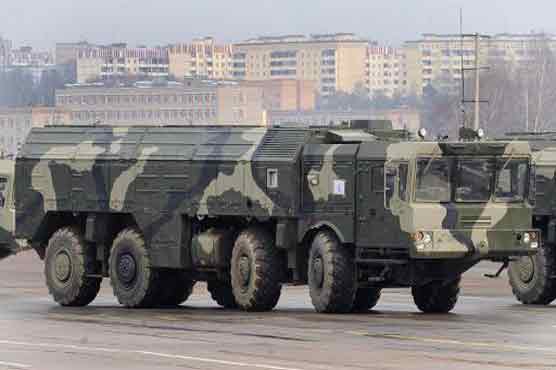
MOSCOW (AFP) - Russia revealed on Monday that its armed forces had moved nuclear-capable Iskander missiles closer to Europe's borders in response to the US-led deployment of a disputed air defence shield.
The advanced version of the Russian missile has a range of 500 kilometres (310 miles) and could potentially be used to take out ground-based radar and interceptors of the new NATO shield.
The announcement prompted fears in the US and neighbouring states such as Poland.
"We've urged Russia to take no steps to destabilize the region," State Department deputy spokeswoman Marie Harf said in response, adding the US had also passed on to Moscow its neighbours' concerns.
Those concerns were voiced earlier on Monday.
Poland's foreign ministry called the planned missile movement "disturbing".
"This is a matter for NATO and we can expect possible consultations and action (...) at the NATO and EU level," added the ministry in a statement.
Estonia, Lithuania and Latvia called the news "alarming".
Latvia's Defence Minister Artis Pabriks, quoted by the Baltic News Service (BNS), said: "It is clear that it is alarming news as it is one of the arguments changing balance of powers in our region."
He added "several Baltic cities" were threatened by the move.
Germany's Bild newspaper first reported over the weekend that Russia had deployed about 10 Iskander systems in its Kaliningrad exclave -- wedged between Poland and Lithuania -- at some point in the past year.
A top Russian defence official said in response to the report that several Iskander batteries had been stationed in Russia's Western Military District -- a region that includes the exclave and also borders the European Union's three Baltic nations that were once a part of the USSR.
"Iskander operational-tactical missile systems have indeed been commissioned by the Western Military District's missile and artillery forces,"
Russian news agencies quoted defence ministry spokesman Igor Konashenkov as saying.
He added that Russia's deployment "does not violate any international treaties or agreements" and should therefore not be subject to protests from the West.
The Kremlin warned in 2011 that it could station the short- and medium-range ballistic missiles along the European Union's eastern frontier in response to NATO's missile defence programme.
Both the United States and the Western military alliance have argued that the shield is not aimed at Russia but is designed to protect the West from potential threats from so-called "rogue states".
But Moscow fears the system -- whose components include missile-positioning satellites -- may one day be turned into an offensive weapon that targets Russian soil.
The Kremlin also believes the shield could in the future be expanded to a point that makes Russia's own vast nuclear arsenal ineffective.