Summary Turkey warned on Monday that it may bring in the army to help quell anti-government protests.
ISTANBUL (AFP) - Turkey warned on Monday it may bring in the army to help quell nearly three weeks of nationwide anti-government protests as two major union federations went on strike over police violence against demonstrators.
The government raised the threat of putting soldiers on the streets after a weekend of violent clashes sparked by the eviction of campers occupying Istanbul s Gezi Park, the epicentre of the protest movement.
Police "will use all their powers" to end the unrest, Deputy Prime Minister Bulent Arinc said in a televised interview. "If this is not enough, we can even utilise the Turkish armed forces in cities."
The deployment of the military, the self-described guardian of the secular state, would mark an escalation of a crisis posing the biggest challenge yet to Prime Minister Recep Tayyip Erdogan s Islamic-rooted government.
But after losing their focal protest site, with Gezi Park and the adjoining Taksim Square still guarded by police on Monday, the demos appeared to lose some of their intensity.
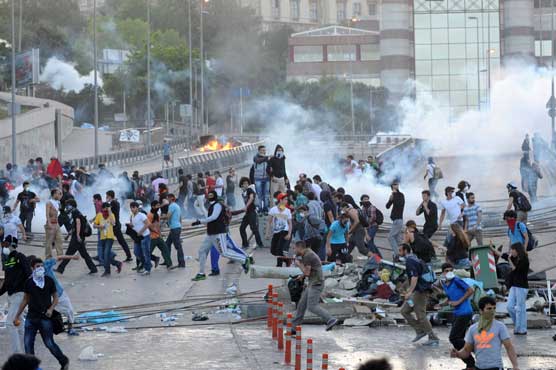
The more subdued mood was in stark contrast to the weekend, when riot police fired volleys of tear gas and jets of water in hours-long running battles with thousands of protesters.
Groups of hundreds of striking workers from the KESK and DISK union federations took to the streets in Istanbul, Ankara and the western city Izmir calling for the police violence against protesters to end immediately and chanting "Erdogan, resign!".
Their progress was at times blocked by officers backed by water cannon trucks but there were no reports of fresh clashes.
The unions turnout was smaller than when they marched in support of the demonstrators on June 5.
After the members dispersed in Istanbul in the evening, some 300 youngsters clashed briefly with police who fired tear gas, water and rubber bullets.
Turkey s crisis began when a sit-in to save Gezi s 600 trees from being razed in a redevelopment project prompted a brutal police response on May 31, spiralling into countrywide demonstrations against Erdogan, seen as increasingly authoritarian.
So far four people have been killed and nearly 7,500 people injured, according to the Turkish Medical Association (TBB).
At a rally of more than 100,000 supporters of his ruling Justice and Development Party (AKP) on Sunday, Erdogan defended his response to the demos, saying it was his "duty as prime minister" to order police to storm Gezi Park after protesters defied his warnings to clear out.
He also vowed to go after those who had offered assistance to the protesters, in a nod to the luxury hotels who opened their doors to people fleeing the clouds of tear gas and jets of water during the park s evacuation on Saturday.
"We know the ones who sheltered in their hotels those who cooperated with terror. They will be held accountable," the combative premier said