Summary Two Croatian generals arrived in Zagreb Friday after being freed by a UN court.
A UN court on Friday acquitted Croatian ex-generals Ante Gotovina and Mladen Markac of war crimes during the bloody 1990s breakup of Yugoslavia, to shouts and tears of joy from their supporters and outrage in Serbia.
The packed public gallery at International Criminal Tribunal for the former Yugoslavia (ICTY) erupted in cheers and applause as Judge Theodor Meron read the acquittal.
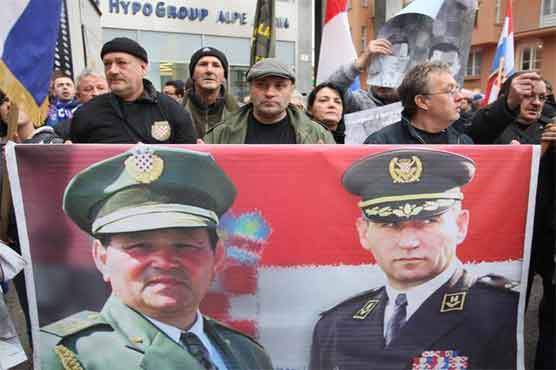
Many people burst out in tears and hugged Markac s wife, Mirjana, who was at the hearing, as supporters outside uncorked champagne bottles.
But Serbia, which still has military and political leaders including Radovan Karadzic and Ratko Mladic on trial at the court, was furious over the acquittal.
"The UN war crimes court has lost all credibility," minister Rasim Ljajic, responsible for the country s cooperation with the tribunal, told the Beta news agency.
"Today s decision is proof of selective justice which is worse than any injustice," he said.
Gotovina and Markac, considered heroes in Croatia, were last year jailed for 24 and 18 years respectively for the murder of Croatian Serbs during their country s struggle for independence and the bloody, ethnically driven break-up of Yugoslavia.
But the court rejected the premise on which the initial convictions had been based, namely that any artillery that landed on Serb-inhabited towns and was more than 200 metres (yards) from a military target amounted to an attack on civilians.
Judges therefore also overturned the finding of "a joint criminal enterprise whose purpose was the permanent and forcible removal of Serb civilians from the Krajina region."
Croatian Prime Minister Zoran Milanovic hailed the acquittals but admitted that "the Croatian state" had made mistakes during the conflict.
Outside the courthouse supporters uncorked champagne while singing Croatian nationalist songs. Candle-lit vigils were held the night before the ruling around Croatia, which will join the European Union in July, having fulfilled the condition of handing over war crimes suspects to the court based in The Hague.
A third accused, Ivan Cermak, who was deputy Croatian defence minister at the time, was acquitted.
The prosecution said 324 Serb civilians and soldiers were killed and "close to 90,000 Serbs were forcibly displaced with the clear intention that they never return."
Serb victims associations put the numbers at 1,200 civilians killed and 220,000 refugees.
Asked about crimes committed by Croat troops before and after the shelling of Serb towns, mentioned by Judge Meron, lawyer Kehoe said "those crimes have to be investigated."
Gotovina, the highest-ranking Croatian army officer tried by the court, and Markac appealed their sentences in May, with their lawyer disputing that Croatian artillery ever targeted civilians, something appeals judges agreed with.
Prosecutors had argued that Operation Storm was a "joint criminal enterprise", devised by the late Croatian president Franjo Tudjman and senior Croat military commanders to drive Serbs from the country.
Gotovina, seen by his supporters as the man who helped liberate Croatia in the chaotic aftermath of the collapse of the Soviet Union, was arrested in a luxury hotel in the Spanish Canary Islands in December 2005 after almost four years on the run.