Summary Participants painted their faces and donned elaborate costumes to embody the iconic Mexican skeleton character in one of the city's most anticipated annual events
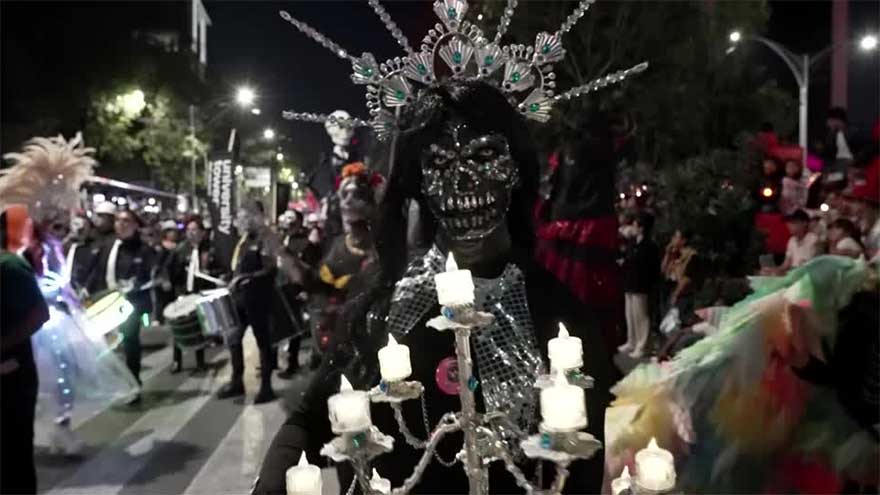
(Reuters) – Mexico City's main avenue transformed into a spectacle of skeletal figures Sunday night as hundreds of participants dressed as "La Catrina" paraded through the capital to mark the beginning of Day of the Dead festivities.
Participants painted their faces and donned elaborate costumes to embody the iconic Mexican skeleton character in one of the city's most anticipated annual events.
The parade is among numerous celebrations held throughout Mexico City for Day of the Dead, a pre-Hispanic tradition in which families honour deceased loved ones and celebrate life's continuity.
Day of the Dead, celebrated on November 2 and known as "Dia de Muertos" in Spanish, blends Spanish colonial influences with indigenous practices of ancestor worship.
WHAT IS DAY OF THE DEAD AND WHEN IS IT CELEBRATED?
Day of the Dead is primarily observed in Mexico and parts of Latin America, including Bolivia, Guatemala, and El Salvador.
The tradition has two roots. One is Catholic, where All Saints’ Day and All Souls’ Day are celebrated on November 1st and 2nd. The other comes from Indigenous Mesoamerican cultures, particularly in central Mexico, where harvest festivals and ancestor worship were held between October and November. Over centuries, these two traditions blended into what is now known as Day of the Dead.
With evangelization, Indigenous rituals were adapted to the Christian calendar, giving rise to a unique syncretic celebration.
HOW IS DAY OF THE DEAD CELEBRATED?
Day of the Dead is celebrated in diverse ways across Mexico and Latin America. The most widely recognized version comes from central Mexico, where marigold flowers (cempasuchil), altars, and cemetery visits are central.
November 1st is dedicated to children and adolescents who have died—those considered to have passed before committing their first sin—November 2nd honors deceased adults.
Families build altars in their homes with photographs of the departed, favorite foods, drinks, and personal items. These offerings are meant to welcome the spirits back home.
On November 2nd, families visit cemeteries to spend time at the graves of their loved ones, decorating the tombs, holding vigils, sharing meals, and playing music.
In cities like Mexico City, large public parades have become part of the celebration, including the now-iconic Catrina parade and other festivities inspired by popular culture, such as zombie walks.
THE SYMBOLISM OF DAY OF THE DEAD
Day of the Dead symbolizes the temporary return of the souls of the departed to the world of the living. It is a celebration of life and death as part of a natural cycle, a moment to connect with ancestors and honor their memory.
The offerings on altars are believed to nourish the spirits, who enjoy the essence of the food and drink provided.
In Mexico, the celebration also serves as a space to commemorate collective grief and historical trauma, including the disappearance of thousands of people and the 1968 student massacre.
WHY DOES DAY OF THE DEAD MATTER?
Day of the Dead is one of Mexico’s most important cultural celebrations and has become a global symbol of Mexican identity.
It honors the memory of loved ones while celebrating the enduring connection between the living and the dead. It also reinforces national identity and community bonds through shared rituals and storytelling.
Recognized by UNESCO as Intangible Cultural Heritage, the Day of the Dead is one of Mexico's most iconic celebrations, blending pre-Hispanic beliefs with Catholic traditions.