Updated on
Summary A garbage collector in Argentina enjoys fame after constructing his home with plastic bottles.
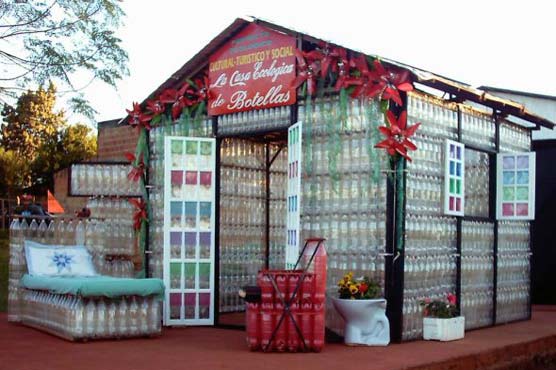
A mans home is his castle, as the old phrase goes. This castle just happens to be made out of thousands of plastic bottles.Argentinas province of Misiones, with its striking red soil, is one of the countrys poorest areas. But behind what may seem like a bizarre entranceway in the city of Puerto Iguazu, is the story of one man who has carved out his fame in plastic bottles.Alfredo Santa Cruz survived during Argentinas economic crash in 2001 by sorting through rubbish heaps in search of items he could sell.Now he works as a tourist guide who shows people how he built a family home out of the bottles he used to collect for a living.Cruz invented an interlocking system to quickly build large bottle panels in a matter of days but says he owes it all to the people that helped him out when he was a garbage collector. Cruz first started experimenting with a playhouse for his three children.When he realized that the milk cartons he had used for the roof and the interlocking system of bottles he had designed for the walls were very sturdy and resistant he started work on a grander scale.A project involving 24,000 plastic bottles is now underway which Cruz wants to turn into a museum and learning centre.Cruz says plastic bottles are a better solution that people might think for temporary shelters in poverty-stricken areas, where flammable materials are often used to construct makeshift shacks.The bottles can be filled with sand or water prior to assembly to reduce fire risks and are and waterproof and wind resistantOn the inside is a small home that Cruz and his family once lived in, complete with CD disc cover shutter windows, and even furniture, that Cruz has already taught hundreds how to build so they dont have to sleep in the dirt or out in the open.Cruz and his family now work to recycle all manner of things.Handbags made from the plastic straps used in packaging, beer cans turned into sugar pots and beer tabs knitted into belts.For Cruz it is an ecological solution as well as a social one.