Summary some of these molecules could be part of the chain of chemical reactions that ultimately lead to life
(Web Desk) - Saturn's moon, Enceladus, could harbour alien life deep within its underground oceans of water, according to the European Space Agency (ESA).
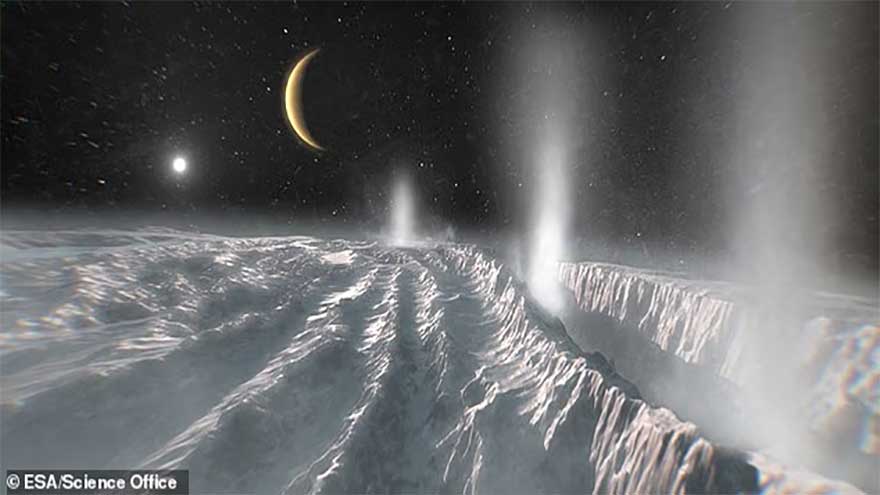
Although the moon may appear barren, near the South Pole, tiny grains of ice are constantly being spewed into space through cracks in the icy surface.
Using data collected by the Cassini spacecraft, scientists have found that these ice crystals are packed with complex organic molecules.
According to a new study, some of these molecules could be part of the chain of chemical reactions that ultimately lead to life.
The researchers say this discovery means Enceladus now 'ticks all the boxes' to be a world capable of supporting life.
The moon has a constant supply of liquid water, a source of energy from hydrothermal vents, and the right set of chemical elements and complex organic molecules.
This isn't necessarily proof that life already exists on Enceladus, but it makes it much more likely that Saturn's moon is habitable.
Lead researcher Dr Nozair Khawaja, of Freie Universität Berlin, says: 'Even not finding life on Enceladus would be a huge discovery, because it raises serious questions about why life is not present in such an environment when the right conditions are there.'
With a diameter of 310 miles (500 km) – about as wide as Arizona – Enceladus is Saturn's sixth–largest moon.
On the surface, conditions are exceptionally cold with temperatures as low as –201°C (–330°F).
However, in 2005, scientists discovered that a huge liquid ocean was actually trapped beneath the icy shell.
Jets of water erupt like geysers through cracks near the South Pole and, while some fall back down to the surface, some escape and form a ring around Saturn that traces the moon's orbit.
When the Cassini spacecraft flew through Saturn's rings, it took samples of these ice grains and found that they showed signs of complex chemical reactions that could be associated with life.