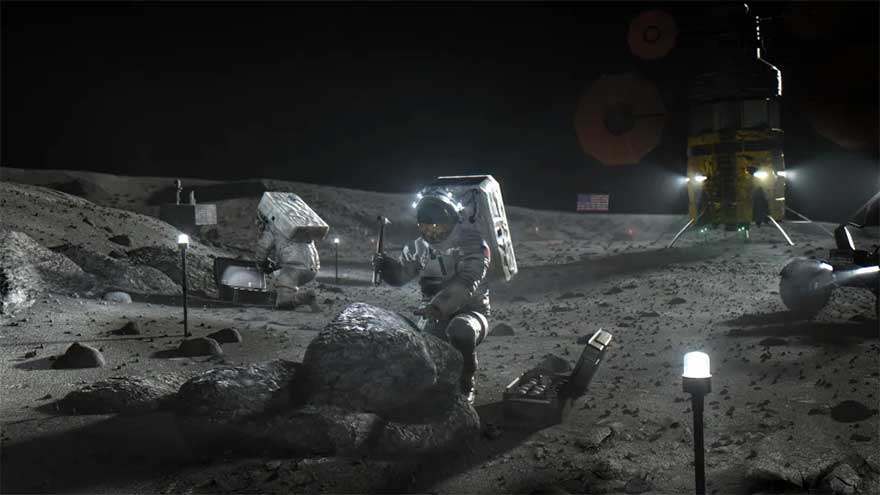
Summary A new paper suggests that the Moon may be hiding a large amount of platinum-group metals
(Web Desk) - Treasure could be lurking just out of sight on the Moon – just waiting to be extracted.
That's the idea put forward by scientists who say our lunar neighbour could be hiding a vast resource with "profitable" potential.
A new paper suggests that the Moon may be hiding a large amount of platinum-group metals.
That includes platinum itself, as well as other elements like rhdoium and palladium.
Precious metals are rare and naturally occurring, and have high economic value and utility.
And scientists think that there may be as many as 6,500 craters – more than a kilometre wide – containing platinum group metals.
Scientists think they arrived on the Moon via asteroid impacts.
And it gives hope to the prospect of space mining, which would expand humanity's access to rare resources beyond what we have on Earth.
"We estimate an upper limit of 6,500 craters with asteroid remnants containing significant amounts of platinum group metals," the study reads, as published in the Planetary and Space Science journal.
In the past, space mining interest has largely been focused on asteroids.
The idea of mining asteroids is promising because space contains far more metal than we have on Earth.
And mining is a damaging and polluting process that can often involve physical danger too.
Scientists have been hunting for near-Earth asteroids that contain enough metal for it to be profitable to extract the ores and return them to Earth – even counting the cost of the mission.
But now scientists suspect that an easier opportunity could be to simply mine the Moon instead, after surveying craters to determine which could have been created by ore-bearing asteroids.
"These values are one to two orders of magnitude larger than the number of ore-bearing near-Earth asteroids," said Jayanth Chennamangalam, the lead author on the study.
"Implying that it may be more advantageous, and hence more profitable, to mine asteroids that have impacted the Moon.
"Rather than the ones that are in orbit."
The study also suggests that there may be as many as 3,400 impact craters that contain water.
This water, in the form of hydrated minerals, could be used by humans as we set up colonies on the Moon.
Nasa is currently planning to send astronauts on a mission around the Moon on the Orion spacecraft using the Space Launch System.
That's the Artemis II mission, which is expected to take place as soon as April 2026.
And this is set to be followed by Artemis III, which will mark humanity's return to the lunar surface.
The last time humans set foot on the Moon was in December 1972, as part of the Apollo 17 mission.
Artemis III is currently slated to take place in mid-2027.
Later Artemis missions will attempt to pave the way for more permanent human occupation of the Moon.
And this could lead to lunar resource extraction, including water locked away in craters – and perhaps one day, even precious ore.