Summary Much of the interstellar medium is in what is called an ionized
(Web Desk) – One of the Earth s longest-flying spacecraft has detected a "persistent hum" beyond our solar system, according to a new study.
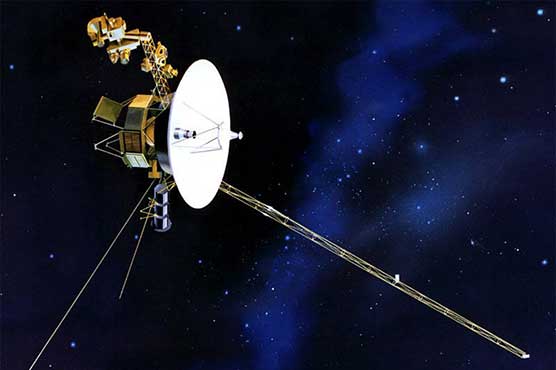
NASA s Voyager 1 launched on September 5 1977, from Cape Canaveral, Florida, aboard a Titan-Centaur rocket, just weeks after its sister craft, Voyager 2. Although they were initially designed to last five years, more than 43 years after they launched, the crafts are still sending back data as they explore interstellar space.
The faint but constant vibrations were picked up by the Voyager 1 spacecraft, which, after more than four decades journeying deep into the cosmos, is the most distant human-made object in space. Scientists say the new discovery, published Monday in the journal Nature Astronomy, is providing a unique and never-before-seen glimpse of the interstellar environment — the frontier beyond the reaches of the sun and planets in our cosmic neighborhood.
"The persistent plasma waves that we ve just discovered are far too weak to actually hear with the human ear. If we could hear it, it would sound like a single steady note, playing constantly but changing very slightly over time," said Stella Koch Ocker, a Cornell University doctoral student in astronomy and lead author of the study published this week in the journal Nature Astronomy.
Much of the interstellar medium is in what is called an ionized, or electrically charged, state called plasma. "Interstellar plasma is extremely diffuse compared to what we re used to on Earth. In this plasma, there are about 0.1 atoms for every cubic centimeter, whereas the air we breathe on Earth has billions of atoms for every cubic centimeter," Ocker said.