Summary The program is specifically designed to find innovative solutions to Pakistan's energy challenges
WEB DESK (Dunya News) – A group of Pakistani graduate scholars that is studying at Arizona State University for this semester, is envisaging the improvement of the energy grid in Pakistan.
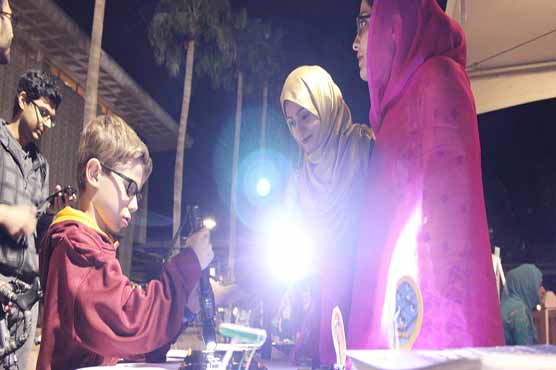
As per details, the students recently demonstrated renewable energy concepts during Arizona State University’s Night of the Open Door — an event during which Phoenix-area residents visit campus, meet faculty and students, and explore research projects.
The toy solar car races at the USPCAS-E demonstration attracted many young guests apart from giving the engineering students an opportunity for elaborating the importance of developing renewable sources of power.
It is worth mentioning here that USPCAS-E is a partnership between ASU and two leading Pakistani universities: the National University of Science and Technology Islamabad and the University of Engineering and Technology in Peshawar.
The program is specifically designed to find innovative solutions to Pakistan s energy challenges and is funded through the U.S. Agency for International Development.
The cohort comprising of 18 men and 11 women, represents the third of its kind to spend a semester at Arizona State University before returning to Pakistan to complete their master s degrees.
This program is allowing Anam Zahara, a NUST grad with a bachelor’s degree in telecommunications engineering, to work on a master’s degree in energy policy with a focus on electrical engineering.
"One thing I’ve learned here is that time is money," she said. "It’s important to be punctual for class."
With a bachelor’s degree in chemical engineering from NUST, Usman Salahuddin from Karachi is now pursuing an advanced degree in energy systems.
"There was not enough gas to feed the furnace, so we’d have to shut down the factory," he explained. "It taught me that we cannot rely on fossil fuels. We must develop renewable technologies that can be safely implemented for industry."
Farah Akram, who holds a power electronics degree from NUST, is now pursuing a master’s degree in electrical power engineering is also an active part of this program.
"The ASU campus is so big that I got completely lost on my first day,” she explained while comparing NUST with ASU. "But everyone was so helpful, and eventually I found my way."
Moreover, the students also declared the cultural exchange through the program as the best experience so far.
"We are not just meeting American students — there are students from five different countries working on one of my lab projects," Usman Salahuddin revealed. "Exposure to these new, wide-ranging perspectives will be incorporated into the problem-solving processes we use when we return home."