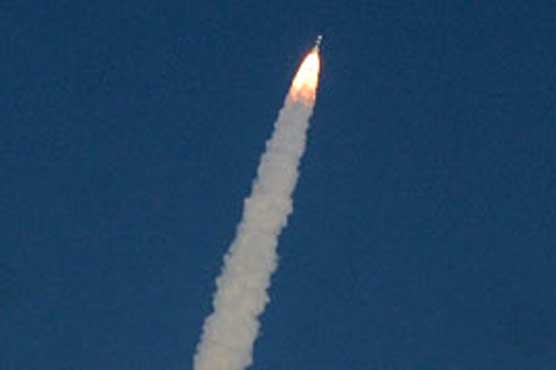
Summary The Mars Orbiter Mission is being launched on its way via an unusual "slingshot" method.
NEW DELHI (AFP) - India s Mars spacecraft was "successfully" raised into a higher orbit around Earth early on Tuesday, after a brief engine failure during an earlier attempt, the space agency said.
The Mars Orbiter Mission, which blasted off on November 5 for a 11-month trip to the Red Planet, is being launched on its way via an unusual "slingshot" method for interplanetary journeys.
Lacking a large enough rocket to blast directly out of Earth s atmosphere and gravitational pull, the Indian spacecraft is orbiting Earth until the end of the month while building up enough velocity to break free.
On Tuesday, the spacecraft completed a fourth repositioning to take it 100,000 kilometres (62,000 miles) from Earth, after the thruster engines failed during an attempt on Monday, leading the auto-pilot to take over.
"Fourth supplementary orbit raising manoeuvre of Mars Orbiter Spacecraft... has been successfully completed," the Indian Space Research Organisation (ISRO) said in a statement.
The first three manoeuvres, which involve firing additional fuel into the rocket s engine, were successfully performed last week.
The ISRO said the brief engine failure on Monday was not a setback to the ambitious low-cost mission.
India has never before attempted interplanetary travel and more than half of all missions to Mars have ended in failure, including China s in 2011 and Japan s in 2003.
The cost of the project, at 4.5 billion rupees ($73 million), is less than a sixth of the $455 million earmarked for a Mars probe by NASA which will launch later this month.
ISRO chairman K. Radhakrishnan has called the mission a "turning point" for India s space ambitions and one which would go on to prove its capabilities in rocket technology.