Summary President Trump said that he had de-escalated eight global conflicts in the preceding eight months, where he cited the Pakistan-India conflict and the Gaza peace plan as examples.
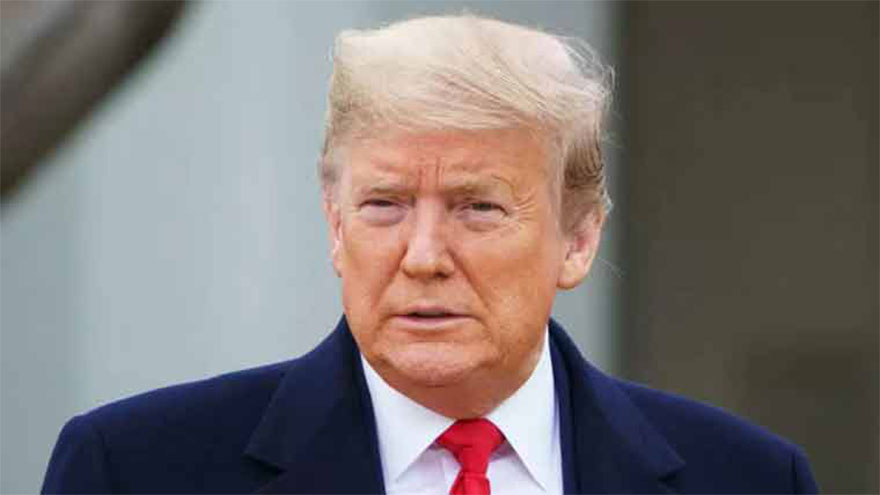
WASHINGTON (Dunya News) - US President Donald Trump on Friday said that he was ready to broker ceasefire deal between Pakistan and Afghanistan, saying, "That's an easy one for me to solve if I have to solve it."
Talking to newsmen at White House, President Trump said that he had de-escalated eight global conflicts in the preceding eight months, where he cited the Pakistan-India conflict and the Gaza peace plan as examples.
Pakistan's Prime Minister Shehbaz Sharif this week hailed Trump for his "exemplary" leadership as world leaders signed a declaration meant to cement a ceasefire and captive-prisoner swap in Gaza.
Sharif has twice endorsed Trump for a Nobel Peace Prize, citing his Gaza peace plan and brokering of a ceasefire during a Pakistan-India standoff in May.
"All of these wars had nothing to do with us, but I saved tens of millions of lives. The Prime Minister of Pakistan said I saved millions of lives in interceding on Pakistan, and you look at Pakistan and India as an example. That would have been a bad one, two nuclear nations, right?" he said.
The development came as Pakistan and Afghanistan on Friday agreed to extend their 48-hour ceasefire until the conclusion of planned talks in Doha, Reuters reported citing its Pakistani and Afghan Taliban sources.
The temporary truce, initially brokered on Wednesday after days of fierce border clashes, paused hostilities that had left dozens dead and hundreds injured. The ceasefire was reportedly extended at Kabul’s request, with high-level dialogue expected to begin on Saturday.
Security sources say a Pakistani delegation will reach Qatar’s capital today (Saturday), while Afghan representatives are due to join soon. The meetings in Doha are expected to focus on preventing future border escalations and addressing Pakistan’s longstanding concerns about militant safe havens inside Afghanistan.
The clashes erupted after Afghanistan launched an unprovoked attack on Pakistani border posts on the night of August 11, killing 23 Pakistani soldiers. In response, Pakistan’s armed forces conducted what officials termed “precision strikes” on militant hideouts in Afghanistan’s Kandahar province and Kabul. Intelligence assessments later confirmed that more than 200 Taliban fighters and affiliated militants were killed in the strikes.
Pakistan’s Foreign Office (FO) confirmed on Friday that both sides are making sincere efforts to find a peaceful solution. “Pakistan and Afghanistan are working towards resolving this complex but solvable issue through constructive dialogue,” FO spokesperson Shafqat Ali Khan told reporters in Islamabad.
Khan emphasised that Pakistan values diplomacy and wishes for a stable, inclusive, and prosperous Afghanistan, but stressed that Kabul must act against terrorist groups operating from its territory. “Pakistan expects concrete and verifiable actions against terrorist elements by the Taliban regime,” he said, referring to militants described by Islamabad as Fitna al-Khawarij and Fitna al-Hindustan—terms used for the banned Tehreek-e-Taliban Pakistan (TTP) and India-backed Baloch insurgent groups.
He reiterated that Pakistan will continue to take “all possible measures” to safeguard its sovereignty and citizens.
Prime Minister Shehbaz Sharif on Thursday reiterated that Pakistan is ready to hold talks, provided Kabul fulfils Islamabad’s “justified conditions”. Speaking during a cabinet meeting, he said, “The message has been sent that if they want to meet our justified conditions through talks, then we are ready. The ball is in their court.”
The recent hostilities mark one of the most serious escalations since the Taliban’s return to power in 2021. The Afghan authorities, however, accused Pakistan of airspace violations and alleged bombings near the border in Paktika province, as well as in parts of Kabul. Islamabad has refrained from directly acknowledging these strikes but maintains that its operations are a legitimate act of self-defence.
In Peshawar, the military spokesman stopped short of confirming the strikes but asserted Pakistan’s right to defend itself. “Afghanistan is being used as a base of operations for terrorism in Pakistan. There is also evidence of this,” Inter-Services Public Relations (ISPR) director general Lt-Gen Ahmed Sharif Chaudhry stated.
Relations between the two neighbours have been strained for months as Pakistan faces a surge in cross-border attacks. Islamabad say the Afghan Taliban regime harbor militants responsible for assaults on its security forces and civilians. Kabul, meanwhile, insists that it does not permit any group to operate against Pakistan from its territory.