Summary 97 people have died in various incidents during floods
LAHORE, KASHMORE, MULTAN, BAHAWALPUR (Dunya News) – The second wave of floods has reached Panjnad, wreaking havoc along the Punjab-Sindh river belt. Several villages in the riverine areas have lost ground connectivity, crops have been destroyed, and two more bodies were recovered in Minchinabad.
The bodies of two young men, who had drowned after a boat capsized near Basti Mamoka in Lalika, a suburb of Minchinabad, were recovered. Flood conditions persist in Jalalpur Pirwala, while embankments in Shujabad and Dhondo have collapsed, with floodwaters from the Chenab sweeping away 138 villages.
Several villages along the Punjab-Sindh border belt have been cut off from land routes. Crops including sugarcane, cotton, rice, vegetables, and others in the riverine tracts have gone under water. The fast currents continue to erode the land, increasing pressure on protective embankments.
In northern Punjab, including Sialkot, Lahore, Gujranwala, Faisalabad, Wazirabad, Sheikhupura, and Kasur, the floodwaters have receded. However, in southern and central districts such as Multan, Vehari, Muzaffargarh, Rajanpur, Lodhran, Layyah, Khanewal, Bahawalpur, and Bahawalnagar, floodwaters remain. Relief camps have been set up in these areas to provide shelter and food to affected families.
According to the Punjab Relief Commissioner, 97 people have died in various incidents during the recent floods, while more than 4,500 villages have been affected by flooding in the Ravi, Sutlej, and Chenab rivers. The Chenab alone has inundated 2,334 villages, the Sutlej 672 villages, and the Ravi 1,482 localities.
Overall, 4.498 million people have been affected, with 2.451 million shifted to safe locations. A total of 396 relief camps have been set up, and over 1.901 million livestock have also been relocated to safer areas.
Read more: Evacuation process in Inayatpur area of flood-hit Jalalpur Pirwala completed
In Muzaffargarh’s Alipur tehsil, a dispute broke out in Khair Sadat over cutting embankments to release floodwater. Both sides resorted to baton use. According to police, the dispute arose over attempts to divert water from one locality to another.
In Bahawalpur and Bahawalnagar, several villages including Santika, Yaseen Ka, Akoka Hathaṛ, and Sahoka have been cut off from nearby towns, leaving residents in difficulty. In Ahmedpur East tehsil of Bahawalpur, over 100 villages have gone underwater.
Near Dhondo, a breach has reappeared in the Chenab’s protective embankment, posing serious threats to nearby villages. During efforts to plug the 80-foot-wide breach, three workers were swept away, with rescue teams saving two while one remained missing.
Machinery has been summoned to repair the breach, while Basti Mitho, Soman, and Basti Bangala have been affected, forcing residents to evacuate.
In Kahror Pakka, the Sutlej’s floodwaters swept into riverine areas, overwhelming embankments. The protective bund at Jhok Ahir collapsed under the river’s force, inundating villages Ain Wahan and Jhambee Wahan, submerging crops over a vast area.
Floodwater entered homes, forcing residents to build makeshift bunds for protection, while rescue teams shifted another 500 stranded people to safe places.
At Panjnad, a very high flood level was recorded in Uch Sharif, where inflow reached 665,576 cusecs, crossing 700,000 cusecs at around 2 a.m. Federal Minister Dr. Musadik Malik confirmed that the second flood wave had reached Panjnad and said preparations were in place, adding that the monsoon would end in a few days.
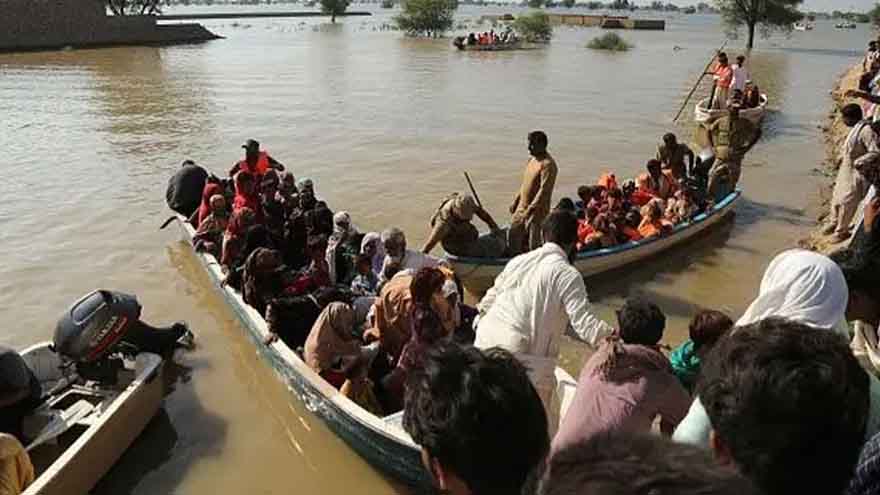
After devastating Punjab, floodwaters entered Sindh, prompting evacuations from riverine areas. In Kashmore’s katcha belt, residents were being moved to safe places by boats, while villagers in Dadu refused to leave.
At Hub Dam, the water level has reached 338 feet after heavy rains, leaving only one foot of storage capacity. Residents along the Hub River have been advised to evacuate, while stone-crushing plant operators were directed to shift machinery and labor to safer areas.
At Guddu Barrage, the Indus has been in medium flood for six consecutive days, with inflow recorded at 512,662 cusecs and outflow at 480,455 cusecs. Rising water levels have submerged several villages along the riverbanks. In Naushahro Feroze, flood conditions have worsened due to the high flow of the Indus, forcing many families to migrate on their own as their settlements were inundated.