Summary The analysis was given in the program Tonight with Moeed Pirzada.
Dr Moeed Pirzada, Editor Strategic Affairs Dunya News, in his program proved with the help of crime figures obtained from Police organizations in Punjab, Sindh and Khyber Pakhtunkhwa that serious crime like murder, attempted murder, sectarian killing and gang rape has shown significant reduction in the first nine months (January to September) of 2015 as compared to the corresponding period of last year.
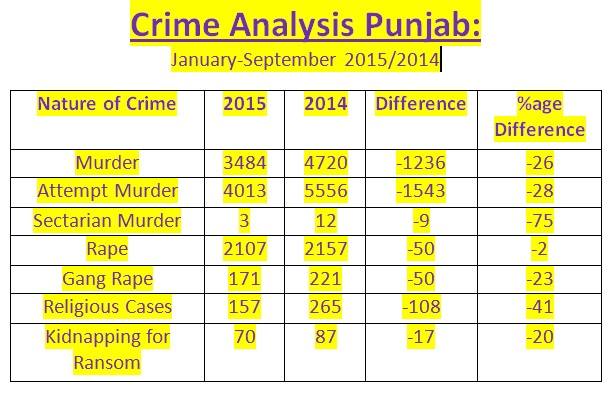
He argued that this is a huge success and positive return of the decisions taken by Pakistani government, military establishment and Pakistan’s political parties in the form of National Action Plan. Results clearly show that the Pakistani societal order is gaining stability and life of citizen is becoming safer than before. Crime figures presented in the program showed that between January to September 2015, as compared with the same period last year, murder across Punjab declined by 26 percent, attempted murder declined by 28 percent, sectarian murder by 75 percent, religious cases by 41 percent and kidnapping for ransom by 20 percent. He however pointed out that whereas gang rape across Punjab showed a decline of 26 percent, the conventional rape has only reduced by 2 percent. Anchor argued that this is probably due to the fact that perpetrators of conventional rape are seldom apprehended and punished, and therefore do not fear the consequences of their actions.
.jpg)
Research in “Tonight With Moeed Pirzada” showed with the help of tables that between January to September 2015, 3484 cases of murder were registered as compared to 4720 in the corresponding period of 2014; this difference of 1236 less murder, is a reduction of 26 percent. Similarly 4013 cases of attempted murder were registered in this period as compared to 5556 cases in the corresponding year of last year; thus the decrease of 28 percent.
.jpg)
Situation in Sindh and KPK also showed marked improvement. For Sindh total of 1297 murder cases were reported as compared to 2326 cases last year. This decrease of 1023 cases is a remarkable reduction of 44 percent this year. Most of this probably relates to Karachi and is a huge testimony to the success of Rangers led operation in the city. The picture of crime across Khyber Pakhtunkhwa shows similar trend. Murder has reduced by 22 percent, attempted murder by 9 percent, kidnapping for ransom 48 percent, terrorism by 55 percent and rape by 15 percent. Dr Pirzada however argued that despite some overlap and moral effect of executions somewhat different reasons may be at work in different Provinces. The moral effect of death penalty has been maximum across Punjab where at least 242 murderers have been executed in the last 9 months. Most murders in Punjab also take place in the setting of family, baradari, clan and village feuds. This massive crime figure across a hundred and ten million people in Punjab is related less to terrorism and target killings, unlike the patterns that have been seen across Karachi and Khyber Pakhtunkhwa. The unique feature of Sindh crime reduction appears related to Rangers action in Karachi that has decimated the traditional and entrenched criminal gangs of Karachi. Over all improvements of policing across Khyber Pakhtunkhwa under a political setup that has given the IGP Nasir Durrani a free hand in setting standards of policing seems to be responsible for better results.
Barrister Sarah Bilal, Head of Justice Project Pakistan also joined in one segment of this program. She is a fellow with British human rights NGO Reprieve and had taken lead in orchestrating the “Save Shafqat Campaign”. All data received from Police organizations were shared with Sarah Bilal before the program. She however refused accepting the data or any result that could be drawn from it. Her argument was that Police organizations are not familiar with research methodologies and therefore whatever data they collect on report is essentially flawed. Dr Pirzada pointed out that these Police figures are mere simple calculation of FIRs registered across different districts of Punjab, Sindh and Khyber Pakhtunkhwa and as such no sophisticated research methodology is needed to collect these figures or to draw simple conclusions thereof.
Dr Pirzada reminded his viewers that every country and nation has to make its own decisions to respond to its unique challenges. This is what constitutes national sovereignty. And results of National Action Plan have started proving that strategic decisions taken by Pakistani Government and Establishment, despite criticism by Europe Union, United Nation, International NGOs and Media are yielding results for the Pakistani nation state. Pakistan has started to become more politically stable and safer for its myriad citizens.