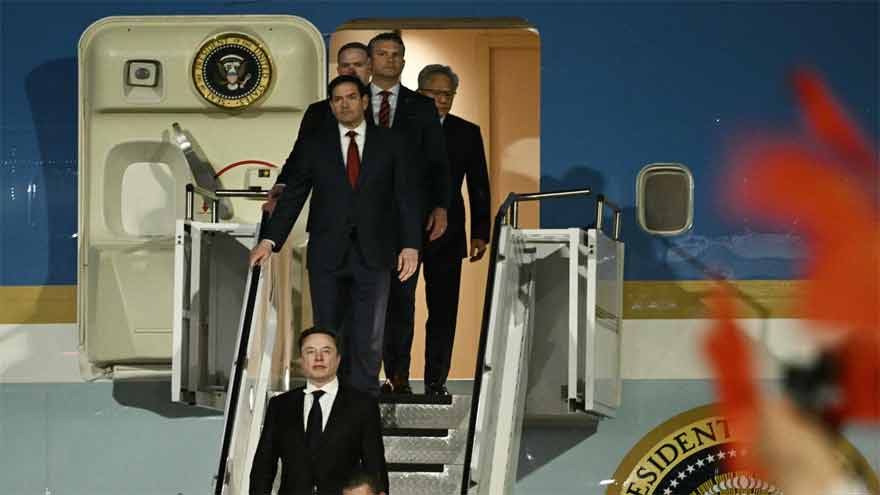
Summary The visit is being closely watched globally as both countries are expected to hold high-level talks on key issues including trade imbalances and artificial intelligence
BEIJING (Web Desk) - US President Donald Trump arrived in China on an official diplomatic visit, receiving a grand red-carpet welcome as Washington and Beijing prepare for crucial discussions on trade, technology, and regional security.
The visit is being closely watched globally as both countries are expected to hold high-level talks on key issues including trade imbalances, artificial intelligence, Taiwan, cybersecurity, sanctions, semiconductor exports, and military influence in the Pacific region.
Accompanying President Trump is a high-profile delegation of American business and technology leaders, highlighting the economic and technological importance of the trip.
Among those traveling with the US president are Elon Musk, Nvidia CEO Jensen Huang, and Apple CEO Tim Cook.
The delegation also includes BlackRock CEO Larry Fink, Blackstone co-founder Stephen Schwarzman, Citi CEO Jane Fraser, Goldman Sachs CEO David Solomon, and Cargill CEO Brian Sikes.
Analysts believe the inclusion of top technology executives signals that artificial intelligence, advanced chips, electric vehicles, and global supply chains will dominate discussions between President Trump and Chinese President Xi Jinping.
Many major American firms continue to maintain deep business ties with China despite rising tensions between the two countries.
Apple remains heavily reliant on Chinese manufacturing facilities, while Tesla operates one of its largest production plants in Shanghai.
China also remains a key market for semiconductor companies such as Nvidia and Qualcomm.
Particular attention has focused on Nvidia CEO Jensen Huang, as Nvidia’s advanced AI chips have become central to the growing technological rivalry between Washington and Beijing.
The United States has imposed restrictions on the export of high-end AI chips to China over national security concerns, while American chipmakers continue pushing for wider access to the Chinese market.
The Trump administration is hoping the visit could pave the way for new commercial agreements, improved market access for US firms, and fewer operational restrictions on American companies in China.
Officials and analysts say the presence of leading corporate executives may also allow direct discussions on investment opportunities, trade barriers, and future technology cooperation between the world’s two largest economies.