Summary He was of the opinion that couple of power plant projects in Punjab that need heavy investment
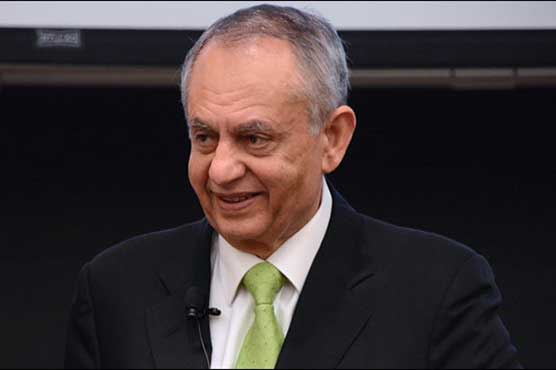
ISLAMABAD (Dunya News) – Advisor to Prime Minister for Commerce, Textile, Investment, Industries and Production Abdul Razak Dawood on Friday said that a major challenge faced by the country is to stop the deindustrialization situation which is alarming and must be reversed. It is an onerous task but it is not impossible.
Addressing a select gathering of 70 CEOs and top businessmen on Friday, he said that the industrial base needs to be reinvigorated and the government has focused itself on a doable export-led growth strategy that would attract investors to establish more export based industries.
“I assure you that the government would ensure and provide all protection to the industries so that the engines of economy continue ticking," Dawood said.
The adviser further disclosed that the Commerce and Finance Ministries have developed the National Tariff Policy that would have a three-year duty structure so that the ad hoc syndrome of fixation of duties would end once and for all. This Policy would go a long way in instilling confidence in trade and industry and would bring about transparency, determine actual global prices, and reduce corruption and evasion.
He said that on November 4, a Chinese buyers expo is being held in China and that Pakistan has been given the status of guest of honor. He advised the business community to take advantage of this and participate in the Expo where Pakistan has been given two strategic stalls. He further advised that Pakistani exporters must study and determine what products could be exported to China.
The adviser also informed that on September30, a strong Saudi Arabian delegation will visit Pakistan with the sole intention of investing in Pakistan. This is a marked change from the past when individual investors would usually come to study the investment climate. However, this mission is determined to invest in many sectors and that the government would be fully involved in facilitation and support.
He was of the opinion that there are couple of power plant projects in Punjab that need heavy investment. He also said that Pakistan needs more cement plants, especially near the sea in Balochistan so that it becomes cheaper to export cement from there due to high inter provincial transportation cost. Pakistan also needs a Naptha Cracker plant that would be ideal investment opportunity for Saudi investors. He also said that the Saudis would be requested to invest in Engineering, Chemical, and Information Technology with focus on exports as well as import substitution.
Dawood went on to say that it is high time Pakistan got out of the 10-10 export regime where ten major commodities and products are exported to ten major markets. The government and private sector should join hands to establish the concept of Pakistan Inc. Pakistan needs a vision of greatness and it is a pity that after seven decades, the vision of greatness is still elusive.
Earlier, Employers Federation of Pakistan (EFP) President Majyd Aziz in his welcome address reminded the advisor that the situation in Pakistan is much more different then the first three years of the Musharraf government when he held the same portfolios in the technocrat Cabinet.
Today, two major political parties and a discredited politico-religious person will be breathing behind the necks of the government. Moreover, every department, every state corporation, every government agency is mired in a quagmire but it is imperative that there is a fundamental change and reforms are implemented. The dynamics have changed and opposition parties as well as social media will make mountains out of molehills.
The EFP president further proposed that an Economic Advisory Council consisting of private sector must be formed and should work in tandem with the Council of Economic Advisors consisting of economists and academicians that was formed recently.
The framework of ‘EFP’s Economic Vision’ mainly depends on achieving a higher rate of GDP growth without disturbing the low-income group of society,” he said and added this higher rate of growth can be achieved through implementing the supply side economic policies that cover investment, industrial, and labor policies. At the same time, for providing immediate reliefs to the weaker segments of the economy, the Vision has suggested some short-term measures in the proposed monetary and fiscal policies.
Conservatively speaking, at least 500,000 new job opportunities could be created due to this seven percent growth in GDP. After enhancement in economic activities, including infrastructure development, fast track privatization program, and lower rate of GST, further acceleration in growth is expected. He added that in order to analyze the future trend of economic growth, EFP performed different simulation exercises based on 5.1 percent, 7 percent, 10 percent and 12 percent rates of growth in GDP.