Updated on
Summary Spain tumbled into recession and European stocks fell Thursday as Greece installed crisis govt.
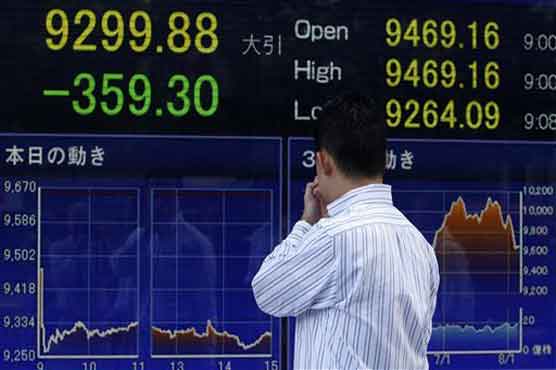
Spain tumbled into recession and European stock markets fell Thursday as Greece installed a crisis government to tackle its crippling debt and top EU leaders prepared for crisis talks.European leaders were to hold a videoconference later in the day, firstly to discuss an upcoming G8 meeting of industrialized countries but also to consider the situation in Greece and elsewhere across the 17-nation euro zone.In Athens, a caretaker government took office to organize the countrys second elections in six weeks after an inconclusive May 6 vote jolted the euro zone.British premier David Cameron was to confer via videoconference with German Chancellor Angela Merkel, new French President Francois Hollande, Italian Prime Minister Mario Monti and top EU officials.The meeting was originally called to discuss a G8 meeting in the United States at the weekend, but Camerons office said the eurozone was likely to come up as well.On Tuesday, Cameron renewed his call for eurozone leaders to take decisive action or face the break up of the single currency over the Greek debt crisis.Britain is not a eurozone member but the bloc is a key trading partner and fallout from the debt crisis is having a serious effect on the entire 27-member European Union.Either Europe has a committed, stable, successful eurozone with an effective firewall, well capitalised and regulated banks, a system of fiscal burden sharing, and supportive monetary policy across the eurozone.Or we are in uncharted territory which carries huge risks for everybody, Cameron warned.Those risks were underscored in Madrid, where the national statistics institute INE said that the fourth biggest eurozone economy had contracted by 0.3 percent in the first quarter of 2012.That was the same decline seen in the last three months of 2011 and confirmed that Spain was officially in recession, defined as two straight quarters of economic contraction.The Spanish government paid higher rates to place three- and four-year bonds with wary investors meanwhile, while a state-controlled bank, Bankia, was reportedly hit by heavy withdrawals by clients, a dire situation seen also in Greece this week.Weaker domestic demand had hampered business activity as Spain struggled with austerity measures aimed at cleaning up its finances, the INE said in a statement.Shares in Bankia, which was created in 2010 from a merger of seven savings banks, dropped by 27.49 percent to 1.2 euros in early afternoon trading, less than a third of their value when the shares were listed on July 20, 2011.The daily newspaper El Mundo reported that Bankia managers told the board the bank had lost a similar amount of deposits this week as the 1.16 billion euros ($1.5 billion) withdrawn by clients in the first quarter of the year.The bank had 112 billion euros in deposits from clients at the end of the first quarter.European stocks markets also reacted to the heightened tension, and fell in afternoon trading.Londons benchmark FTSE 100 index was off by 1.09 percent at 5,346.56 points.Fears of a Greek exit from the eurozone continue to linger, despite insistence from European politicians and bureaucrats that there are no plans for the country to leave, said GFT analyst Fawad Razaqzada.Frances new finance minister, Pierre Moscovici, reiterated support for Greece on Thursday, telling BFMTV: The eurozone is a unified zone, it cannot break up.But Moscovici also reiterated that Paris would not ratify a EU budget discipline pact if the document does not include measures to boost growth.What has been said quite clearly is that the treaty will not be ratified as is and that it must be completed with a chapter on growth, with a growth strategy, he said.