


India strips two million, mostly Muslims, of their citizenship in Assam
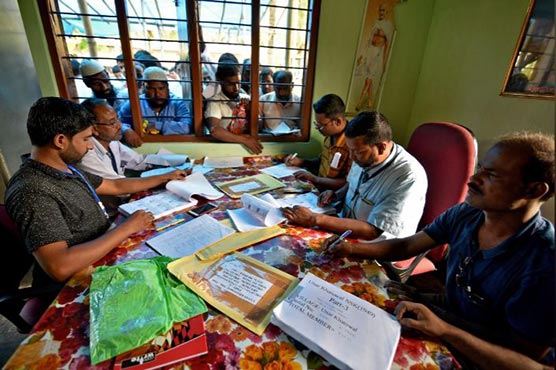
A total of 31.1 million people were included in the National Register of Citizens (NRC).
GUWAHATI, India (Dunya News) – Tens of thousands of paramilitary personnel and police have been deployed in the north-eastern state of Assam in India to tighten the security as the Modi-led Hindu nationalist Indian government targeted minority Muslim community, who form one-third of Assam state’s population, and strip them of their citizenship – in what could become the biggest exercise in forced statelessness in living memory since World War II.
After committing gross human rights’ violations in Kashmir, India has published a disputable citizenship list in what it calls the final National Register of Citizens or NRC for the citizens of Assam.
Prime Minister Narendra Modi’s right-hand Home Minister Amit Shah, who wants to implement the NRC at the national level, once dubbed the migrants as “termites”.
Assam, with a population of 32 million people, is in a state of high alert with the imposition of section 144 and deployment of forces in anticipation of any law and order situation following the publication of the NRC list.
Coming just weeks after the Bharatiya Janata Party’s (BJP) government, in violation of United Nations Security Council’s resolutions, abrogated Jammu and Kashmir’s decades-old autonomy; the NRC too is expected to go down as one of the biggest moves in Modi’s second term.
Human rights experts have raised serious concern over the drive against suspected illegal immigrants in the border state of Assam, warning it could create a humanitarian crisis that disproportionately affects Muslims and the region’s poorest communities.
The United Nations special rapporteur on minority issues, Fernand de Varennes, said the exercise “raises quite a few red flags” and “may be considered to be a discriminatory process and approach”. De Varennes said the number of people potentially affected could make this the biggest exercise in statelessness since the second world war.
The publication of the national register of citizens (NRC) on Saturday follows a four-year process that has caused anxiety across the state. Lawyers say people’s citizenship has been denied on the basis of minor anomalies such as a spelling error in documents produced decades ago.
Modi, who supports the project in Assam, has pledged to roll the process out across the country.
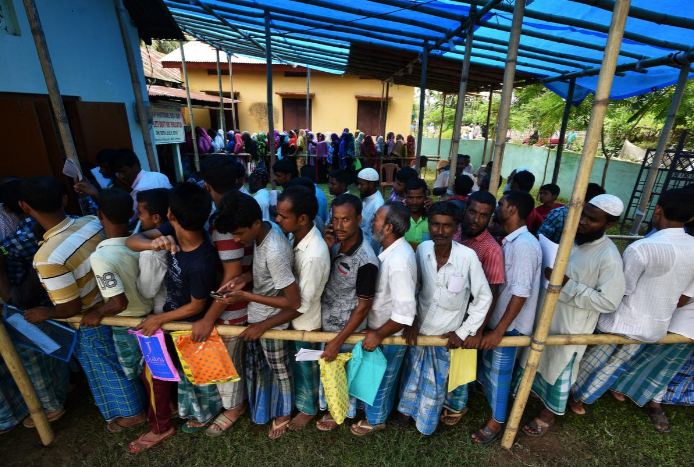
Termites
Members of Indian Prime Minister Narendra Modi’s Hindu nationalist Bharatiya Janata Party run Assam – and critics say the NRC process reflects the BJP’s goal to serve only its co-religionists.
In January India’s lower house passed legislation that grants citizenship to people who moved to India from Bangladesh, Pakistan and Afghanistan as recently as six years ago – as long as they are not Muslims.
This has stoked fears among India’s 170-million Muslim minority for their future.
Home Minister Amit Shah, Modi’s right-hand-man, has called for the ejection of "termites" and said before the BJP’s thumping re-election victory in May that it would "run a countrywide campaign to send back the infiltrators".
Those left off the NRC have 120 days to appeal at special Foreigners Tribunals, which the government says are being expanded in number.
But critics say that tribunal members can be underqualified and are subject to "performance" targets, and that the entire process has been riddled with inconsistencies and errors.
The number of errors has also turned some in the BJP in Assam against the process, with Himanta Biswa Sarma, a BJP minister in the state, saying it had left off "so many genuine Indians".
"We have lost hope in the present form of the NRC," Sarma told reporters, saying that the party was already mulling a "fresh strategy on how we can drive out the illegal migrants"
Camps and suicides
Those who have been rejected by the tribunals and have exhausted all other legal avenues can be declared foreigners and – in theory – be placed in one of six detention centres with a view to possible deportation, although Bangladesh is yet to signal its cooperation.
Ten new such camps have been announced. One with space for 3,000 is being constructed in Goalpara, west of Assam’s capital Guwuhati.
The camps currently hold 1,135 people, according to the state government, and have been operating for years.
Nur Mohammad, 65, spent almost 10 years in one such camp until a Supreme Court order saw him released this month.
"I just want to ask them what is my crime? I was born here and lived in Assam all my life," he told AFP. "I don’t know if my name will be in the NRC or not."
Media reports say that there have been more than 40 cases of suicide caused by concern over the NRC.
Samujjal Bhattacharya from the All Assam Students’ Union (AASU), a key driver behind the NRC, said the register was necessary to protect Assam’s indigenous "sons of the soil".
"We are not ready to live here like a second-class citizens in our own motherland," he said.
Campaigners say the system has created huge uncertainty for people affected, who fear their jobs, land, access to healthcare and their children’s access to education could all be at risk.
“The attitude of the authorities is completely callous,” said Teesta Setalvad, the secretary of Citizens for Justice and Peace, a group that has around 500 volunteers supporting affected communities.
Separately from the register, the BJP is pursuing a citizenship amendment bill, which aims to give citizenship to religious group such as Hindus, Sikhs, Buddhists and others who are minorities in neighbouring countries – but not to Muslims.
Activists of All Assam Students Union and various Assamese ethnic groups protest against India’s Citizenship (Amendment) Bill 2016 in Guwahati in November 2018.
Arrest and deportation
Human rights activists fear that the people who do not find their names on the list might face possible jail term or deportation, and their voting and other civil rights snatched away.
The government has already announced its plan to build more detention centres. Nearly 1,000 people are currently lodged in six detention centres located in the existing district jails.
According to the 2011 census, the state had 61.67 percent Hindus, 34.22 percent Muslims and 3.7 percent Christians among the Scheduled Tribe and Castes population. The Scheduled Tribe population in Assam is around 13 percent, of which Bodos account for 40 percent. Other religions followed include Jainism (0.1%), Buddhism (0.2%), Sikhism (0.1%) and Animism (amongst Khamti, Phake, Aiton etc. communities).
Out of 32 districts of Assam, nine are Muslim majority, according to the 2011 census of India. The districts are Dhubri, Goalpara, Barpeta, Morigaon, Nagaon, Karimganj, Hailakandi, Darrang and Bongaigaon.
With input from AFP
