Summary Von der Leyen told the assembly in Strasbourg that new partnerships were needed in the cold fragility of today’s world
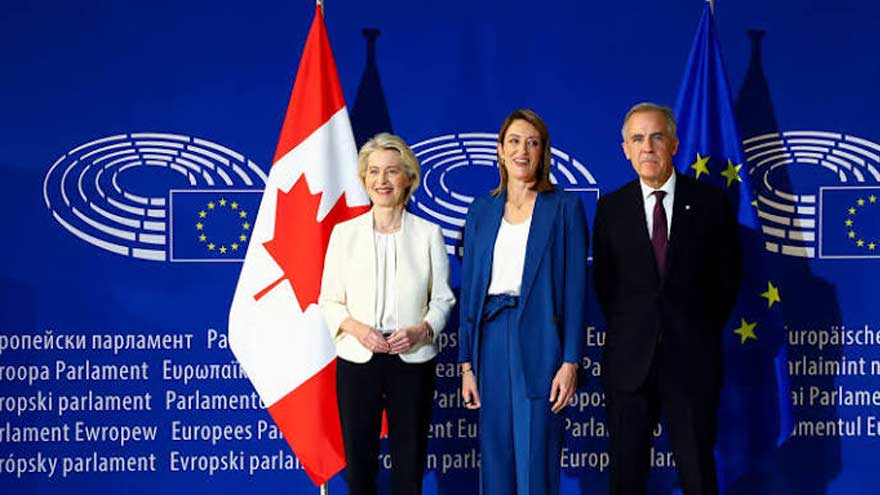
BRUSSELS (Reuters) - European Commission President Ursula von der Leyen said on Wednesday she wanted to open the door to Canada becoming the EU's first "associate member" in a push to forge new links among allies in "an openly hostile world".
EU lawmakers gave a standing ovation after she made the proposal and then walked over to embrace Canada's Prime Minister Mark Carney, who was in the European Parliament to hear her annual State of the Union address.
New partnerships were needed "in the cold fragility of today’s world," von der Leyen told the assembly in Strasbourg.
The 27-nation bloc faces war at its borders, with Russia's invasion of Ukraine. Both the EU and Canada have also been facing stiff rivalry on trade and other issues from the administration of U.S. President Donald Trump and from an increasingly assertive China.
'EUROPE AND CANADA BELIEVE IN DEMOCRACY'
"I said we must urgently reimagine our partnerships. So, I would like to work with you on opening the door for Canada to be the first associate member of the EU," von der Leyen said.
The EU and Canada "see the world with the same eyes: from AI to climate change, from the Arctic to geopolitics. And we have stood together: on Ukraine, on defence, on raw materials and on supply chains. But above all ... Europe and Canada believe in democracy," von der Leyen told the assembly.
It will be up to EU member states, and not von der Leyen alone, whether her proposal goes ahead.
The EU has historically resisted such types of flexible alliances that have no legal status. EU members were lukewarm in reacting to Germany's proposal in May of associate membership for Ukraine as a stepping stone to full accession.
One EU diplomat expressed surprise at von der Leyen's proposal, saying "nobody really knows what it means". The diplomat added there were concerns that the European Commission chief "is overpromising and won't be able to deliver."
Ahead of von der Leyen's speech, seven EU diplomats in Canada and Europe had told Reuters there were active efforts toward deeper collaboration on trade, defense and digital security, but no specific plan for a more comprehensive Canadian-EU relationship had been discussed at a high level.
Significant obstacles also remain to ramping up trade. Mark Manger, a professor of political economy and global affairs at the University of Toronto, has said EU officials have been frustrated by Canada’s refusal to open two industries it protects at great expense: telecommunications and dairy.
'UNIQUE ALLIANCE'
Canada's Carney said earlier this week Canada was seeking a "unique alliance" with the EU but not membership. He will make his own address to the European Parliament on Thursday.
Carney's European trip follows a historic breakdown in Canada-U.S. relations after trade talks collapsed last month, sparking a series of tit-for-tat tariff measures.
He has pledged to double Canada’s non-U.S. trade in the next decade as the country pivots away from its southern neighbour amid an increasingly acrimonious trade war.
Carney said on Tuesday more detailed discussions would begin at the Canada-EU summit in Montreal in late October.
“Our relationship with the EU has become increasingly close, especially over the past year and a half,” Canadian Foreign Minister Anita Anand told Reuters.
In her speech, von der Leyen said the EU and Canada will work together across sectors.
"We will work on intelligent manufacturing. We will create a tech alliance. We will integrate defence industrial bases. We will make the Arctic a flagship joint project," she said.
"Partnerships are a strategic choice for Europe. But they also respond to the fracture in the international rules-based system," she added.
Von der Leyen added, "This is a partnership not against anyone else."