Summary Iran’s state broadcaster published the statement by the council’s secretary, Mohammad Bagher Zolghadr, who is also a commander in the powerful Revolutionary Guard.
TEHRAN (AP) - Iran issued new demands around the reopening of the Strait of Hormuz, and the United Arab Emirates said one of its ships was targeted by an Iranian missile. Yemen’s military attacked the country’s Iranian-backed Houthi rebels. And Turkey’s Kurdish peace bill won approval in parliament.
Here’s a look at developments across the Middle East on Saturday. Full coverage can be found here.
Iran says the strait won’t open until the US ‘corrects’ its behavior
Iran’s politburo-like body known as the Supreme National Security Council said the Strait of Hormuz will not open until the United States “corrects its behavior,” issuing new demands that could shake up talks on a deal to manage the waterway.
Iran’s state broadcaster published the statement by the council’s secretary, Mohammad Bagher Zolghadr, who is also a commander in the powerful Revolutionary Guard.
The United States must never threaten Iran again, the statement said, and must permanently end the war with Iran and its armed allies in the region. The U.S. must lift the naval blockade of Iranian ports and withdraw its military from the area. It must “completely compensate” Iran for war damage, lift sanctions and “unconditionally” release frozen assets.
The U.S., which has wanted an acceptable deal first on the strait before ending the blockade, had no immediate comment. According to the interim deal signed in June, a schedule to end sanctions and plan on compensation would be part of the final deal, and negotiations would address frozen assets.
Iran has said it was close to reaching a separate deal with Oman to manage the strait, which runs between the two countries.
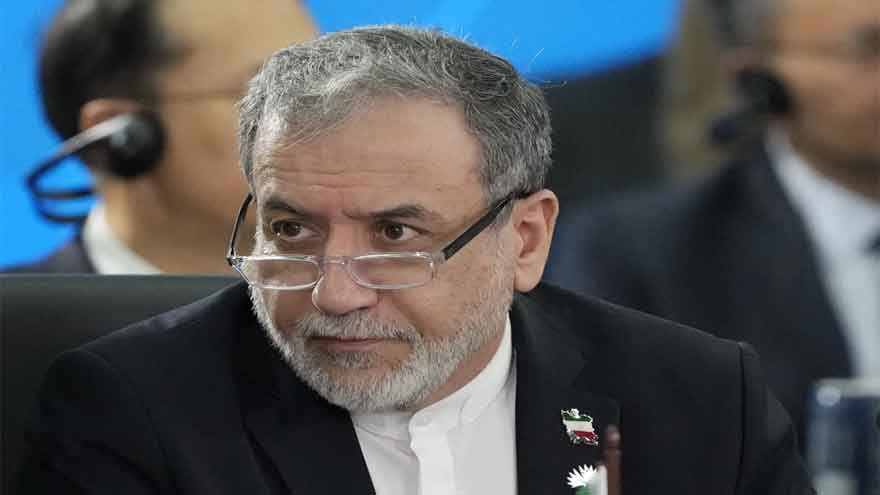
Iranian Foreign Minister Abbas Araghchi earlier Saturday said they were close to reaching an agreement on navigation. But the waterway’s reopening is contingent on other conditions, he said in remarks shared on social media, and blamed the situation on what he called the U.S. violation of the interim deal.
Oman, a mediator Gulf Arab country which has said relatively little on the talks, said in a statement discussions were ongoing “in a positive and constructive atmosphere,” and condemned attacks on ships on the strait.
Details emerge about potential Iran-Oman deal
The strait, crucial to global supplies of oil and natural gas, was considered an international waterway before the war.
The deal Iran and Oman are working to finalize would be temporary, but it would reopen the strait with ships entering the strait through a route close to Iran and exiting through a route close to Oman, according to two people familiar with the talks who spoke on condition of anonymity because they were not authorized to speak publicly.
Ships would cross the strait without paying fees or tolls during the interim period.
The agreement is designed to restore an earlier, separate agreement between the U.S. and Iran and restart a 60-day clock for the two countries to negotiate over Iran’s nuclear program.
During that time, Iran is expected to be able to sell oil. The current 60-day deadline to negotiate a final deal is due to end in just over a week.
According to the two people who spoke about the talks, the deal is endorsed by members of the Gulf Cooperation Council and expected when finalized to be jointly announced by Iran, Oman, the U.S., and the International Maritime Organization of the United Nations. But the people stressed the terms could still change before the deal is final.