Summary "It also reflects a concern that the Trump administration isn't doing anything very useful"
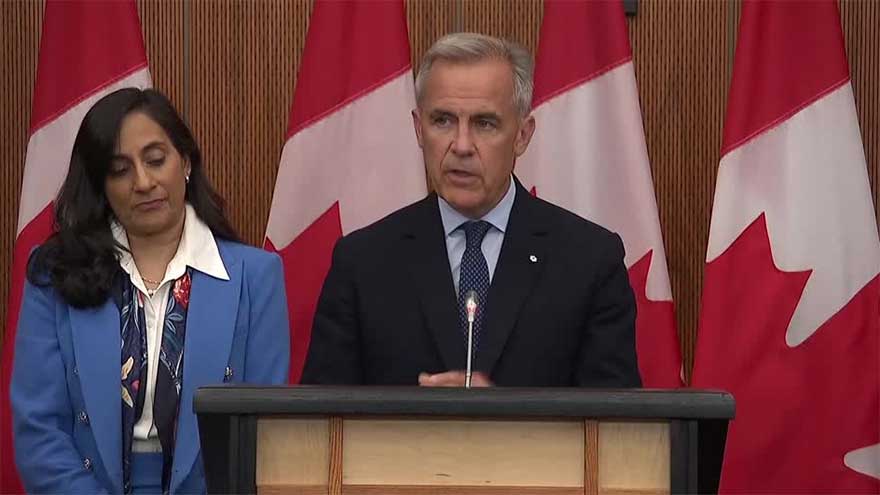
(Reuters) – As Canadian Prime Minister Mark Carney announced that the country plans to recognize the State of Palestine at a meeting of the United Nations in September, some Middle East experts said that while the move is a clear example of Canada shifting its alliance from the US to Europe in the shadow of a rocky relationship with Washington, there is a limit to what the union can do to achieve a two-state solution.
"There are limits to what a European or Western-Euro or global coalition can do. But it also reflects a concern that the Trump administration isn't doing anything very useful. And of course, let's remember that although he kind of waffles on it, the Trump administration was the, it was Donald Trump who rolled out the idea of driving the Palestinian population out of Gaza and turning it into a real estate development. That enabled the Israelis to start talking more explicitly about what is essentially ethnic cleansing and forced displacement," said McGill University political science professor Rex Brynen.
Carney's announcement came after France said last week it would recognize a Palestinian state and a day after Britain said it would recognize the state at September's UN General Assembly meeting if the fighting in Gaza, part of the Palestinian territories occupied by Israel, had not stopped by then.
The State of Palestine has been a non-member observer state of the UN General Assembly since 2012, recognized by more than three-quarters of the assembly's 193 member states. But the announcements by some of Israel's closest allies reflect growing international outrage over Israel's restrictions on food and other aid to Gaza in its war against Hamas militants, and the dire humanitarian crisis there. A global hunger monitor has warned that a worst-case scenario of famine is unfolding in the enclave.
Brynen said that while the move ratchets up pressure on Israel as starvation spreads in Gaza, it also opens the door for Canada, Europe and other allies to consider future selective sanctions against certain Israelis or products made in occupied territories.
"For example, why are products produced in illegal Israeli settlements, which virtually everyone in the Western world considers a war crime ... Will those goods be permitted into the European Union? Will there be movement there? That's a massive market... Will people who hold official positions in settlements – mayors, administrators, police chiefs, security chiefs – will they be admitted in future, in two years, three years, five years into countries?" said Brynen. "I think it moves us in the direction of using legal and trade levers in a way that most of the Western world hasn’t.”
While Brynen does not believe the move will hurt Carney politically at home, he said it was an important gesture as Canada increasingly takes a world stage with European leaders, as its once close relationship with the US is re-examined in light of differences with US President Donald Trump.
"That feeling of we are really not American has been absolutely amplified. And in looking for partnerships, well, who else is there? It's not going to be the Chinese. We have other kinds of issues with the Chinese. It's going to be Europe. And so I think you'll hear a lot of Canadians wanting a closer relationship with Europe... The trade stuff has already been happening, this is an example of the political stuff that those discussions where France, Britain, Canada are doing this,” Brynen said.