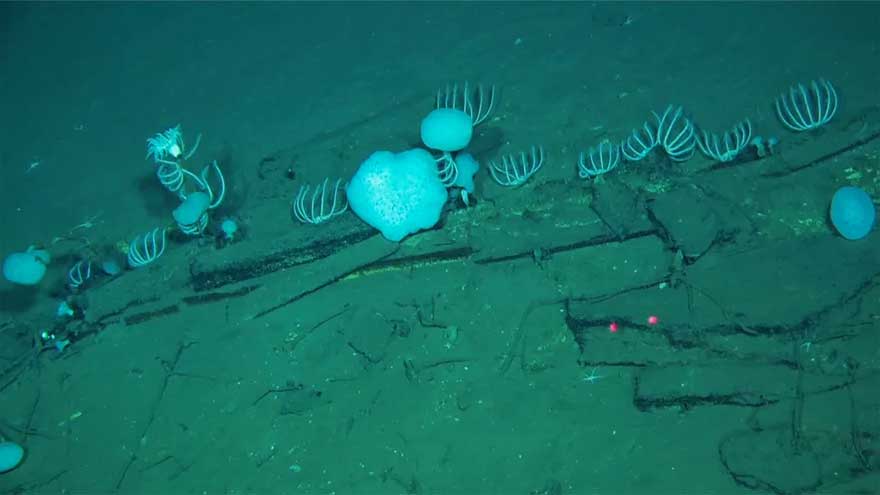
Summary Researchers found jellyfish, tubeworms and brittle stars, sea cucumbers, squat lobsters and saltwater clams that were never seen before elsewhere.
(Web Desk) - A huge 5 million-year-old whale graveyard has been discovered 23,000 feet down the Indian Ocean by a team of researchers.
The 745 miles-long whale graveyard was found in the Diamantina fracture zone, in the south-eastern Indian Ocean – and it brims with new species.
Researchers found jellyfish, tubeworms and brittle stars, sea cucumbers, squat lobsters and saltwater clams that were never seen before elsewhere.
Some of the remains are as old as 5.3 million years.
The underwater necropolis, which is around 4 miles deep, is also populated by species which might be new to science.
The amazing discovery was carried out by a team of researchers from Italy, China and New Zealand.
Scientist Xiaotong Peng, of the Chinese Academy of Sciences, said: “Discovering a necropolis of this scale was completely unexpected.
“The size of distribution, the depth and the age range were far beyond anything we had imagined.”
So far, explorers collected 485 whale-fossil sites and active whale falls, following a total of 32 dives to the abyss.
The skeleton of an extinct whale was found as well, alongside a treasure trove of remains.
The largest of them which has been recovered is an approximately 16-foot-long Antarctic minke whale’s carcass.
Pterocetus diamantinae is the name given by the research team to the new species, named after the place.
Stephen J Godfrey, from the Calvert Marine Museum wrote on Nature: “Peng and colleagues’ encounter with a vast fossil graveyard is a truly unique discovery,
“Although the site has limited accessibility, it seems likely to hold many other exciting finds, and it will no doubt inspire more submersible dives in similar environments.
“Peng and colleagues’ paper reminded me of a trailer for the first in a series of epic movies. I hope that there will be many more of these blockbusters to come.”
The nature of the deep ocean makes these sites extremely difficult to locate.
Scientists mapped the massive whale necropolis for the first time in 2023, collecting some samples.
The peculiar V shape of that stretch of the seabed might have funnelled the remains in the same place.
Studying whale graveyards is important to understand how life can adapt to extreme conditions, including extreme pressure, according to Palaeontologist Giovanni Bianucci, from University of Pisa, Italy, who also took part in the expeditions.