Earth braces for biggest space storm in five years
Dunya News

The full brunt of the space storm is expected to hit the Earth today.

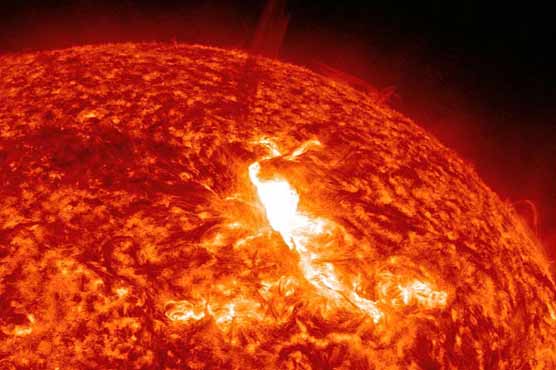
A pair of scorching explosions on the Suns surface is sparking the biggest radiation and geomagnetic storm the Earth has experienced in five years, space weather experts said Wednesday.The full brunt of the storm is expected to hit Earth early Thursday US time and last through Friday, potentially disrupting power grids, GPS systems, satellites, and forcing airplanes to change their routes around the polar regions.Space weather has gotten very interesting over the past 24 hours, said Joseph Kunches, a space weather scientist with the National Oceanic and Atmospheric Administration (NOAA).The fuss began late Sunday at an active region on the Sun known as 1429, with a big solar flare that was associated with a burst of solar wind and plasma known as a coronal mass ejection that hurtled in Earths direction at some four million miles per hour (6.4 million kilometers per hour).Another solar flare and CME followed at 0024 GMT on March 7, setting off a strong geomagnetic and solar radiation storm, both at level three on a five-step scale.NASA said the second flare -- classified in the potent X class -- was one of the largest of this cycle known as the solar minimum which began in early 2007, and fell in just behind slightly stronger one which erupted in August.The current increase in the number of X-class flares is part of the suns normal 11-year solar cycle, during which activity on the sun ramps up to solar maximum, which is expected to peak in late 2013, the US space agency said.The solar flares alone caused brief high frequency radio blackouts that have now passed, according to NOAA.But the ensuing space storm will likely give nighttime viewers in Central Asia a prime look at the aurora borealis, or northern lights, on Thursday night, in addition to possibly garbling some of Earthlings most prized gadgets, Kunches said.The storm is likely the strongest one since December 2006, Kunches said, noting, however, that the Earth experienced a stronger radio blackout last August.But en masse, if you put it all together with the geomagnetic effects and the solar radiation effects, I would put it on par with one at the end of the last solar cycle which was over five years ago.Satellites, power girds and even astronauts aboard the International Space Station could be affected by the radiation storm, which may cause them to seek shelter in better protected parts of the orbiting lab as they have in the past.A NASA spokesman told AFP that no such measures are currently being taken and we do not believe that they are in any danger.However, Kunches said some commercial airlines have already taken actions to reroute and fly further away from the poles.And more such storms could follow in the coming days because region 1429 is expected to stay active, he said.Geomagnetic and radiation storms will grow more frequent as the Sun leaves its solar minimum period and moves into a solar maximum over the coming years, but people on Earth are generally protected by our planets magnetic field.However, some experts are concerned that because the world is more reliant on GPS and satellite technology now than it was during the last solar maximum, more disruptions to modern life are likely.Space storms are not new. The first major solar flare was recorded by British astronomer Richard Carrington in 1859.Other solar geomagnetic storms have been observed in recent decades. One huge solar flare in 1972 cut off long-distance telephone communication in the midwestern state of Illinois, NASA said.Another similar flare in 1989 provoked geomagnetic storms that disrupted electric power transmission and caused blackouts across the Canadian province of Quebec, the US space agency said.
