Summary Comets are a night sky spectacle, soaring across the darkness in a blaze of glory.
(Web Desk) - Stargazers may soon have a chance to spot the “Great Comet of 2026” – potentially the brightest of the year.
Comets are a night sky spectacle, soaring across the darkness in a blaze of glory.
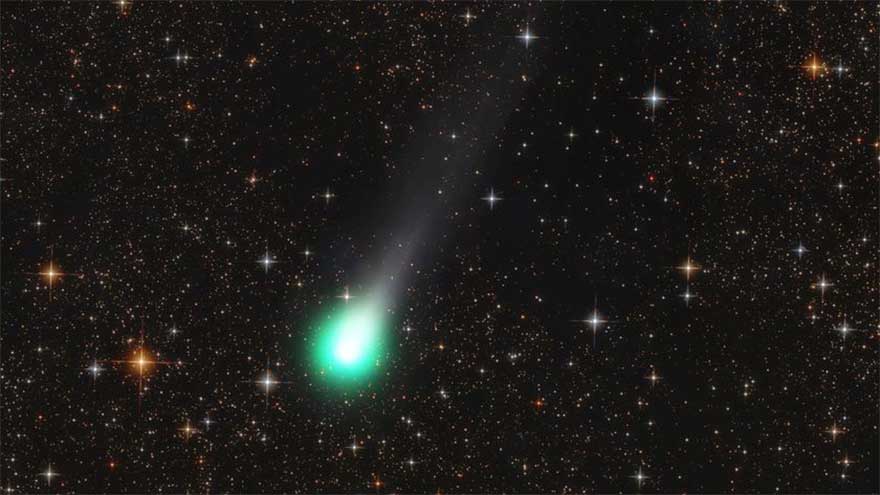
Last year saw several visible comets grace our skies, including Comet C/2025 A6 (Lemmon) (seen above and in this article’s featured pic), which blazed a vibrant green.
And in 2026, we might get a chance to spy C/2025 R3 (PanSTARRS) with the naked eye, as revealed by Space.com.
In April, the comet is expected to reach its closest point to our Sun.
And just a few days after that, it’ll get to its nearest point to Earth.
The comet is a fairly new addition to science, having only been discovered in September 2025.
It was detected by the Panoramic Survey Telescope and Rapid Response System, or PanSTARRS – hence the comet name.
The comet probably takes more than 1,000 years to make a full trip around the Sun, so it’s a rare sight in our skies.
This solar fly-by is expected to take place on April 20.
But it won’t be until April 27 that it reaches its closest point to Earth.
It’ll be just 44 million miles away from our planet. By comparison, the Moon is an average of around 239,000 miles from Earth.
Scientists are torn on exactly how bright the comet will be.
But it could be the brightest of the year – although 2026 may still surprise us.
There’s a chance that it could be visible with the naked eye, or it might need a pair of binoculars or a small telescope.
Astronomers will be able to give better assessments of what to expect from the comet as it gets closer.
If you’re desperate to spy the comet, you’ve got a good chance on April 17.
That’s the date of the New Moon. Just like how a Full Moon that’s very bright makes it harder to stargaze, a New Moon gives you a wonderfully dark sky to stare up at.
Similarly, as the comet approaches the Sun a few days later, the comet might become harder to see.
But in late April, it might become easier to see again.