Summary Webb just spotted a carbon-rich moon factory 625 light-years away, revealing how moons like ours may have first taken shape
(Web Desk) - Our solar system is home to eight major planets and more than 400 known moons orbiting six of them. But how did all those moons come to exist?
Scientists have proposed several ways they could have formed. In the case of the large moons, such as Jupiter’s four Galilean satellites, the leading idea is that they developed from a disk of dust and gas that surrounded the planet as it took shape. That process would have occurred over 4 billion years ago, leaving only faint traces of evidence today.
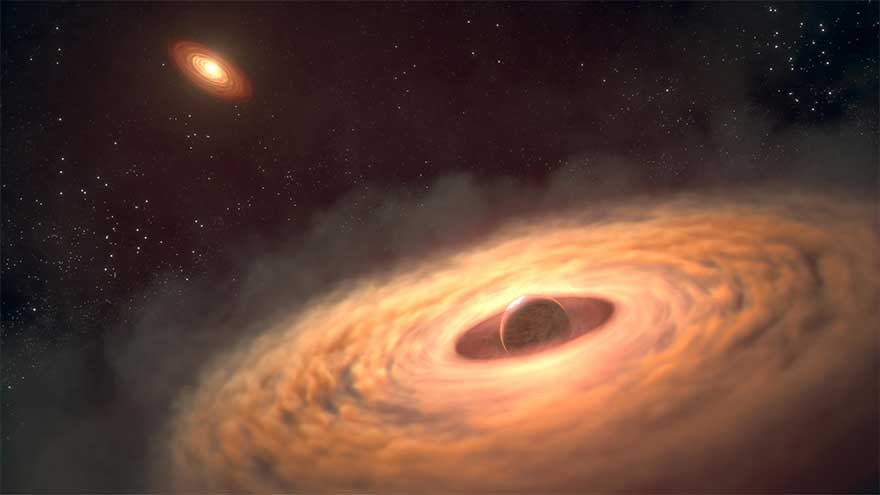
NASA’s James Webb Space Telescope has now captured the first direct look at material within a disk encircling a massive exoplanet more than 625 light-years from Earth. This carbon-rich disk may serve as a kind of workshop where moons take shape. Because moons are thought to outnumber planets across our galaxy, and some could even host life, studying how they form is key to understanding planetary systems as a whole.
NASA’s James Webb Space Telescope has made the first direct measurements of the chemical makeup and physical conditions inside a possible moon-forming disk surrounding a massive exoplanet. This carbon-rich disk, found around the planet known as CT Cha b about 625 light-years from Earth, could be a birthplace for new moons, although none were detected in the current Webb observations.
The findings were recently reported in The Astrophysical Journal Letters.