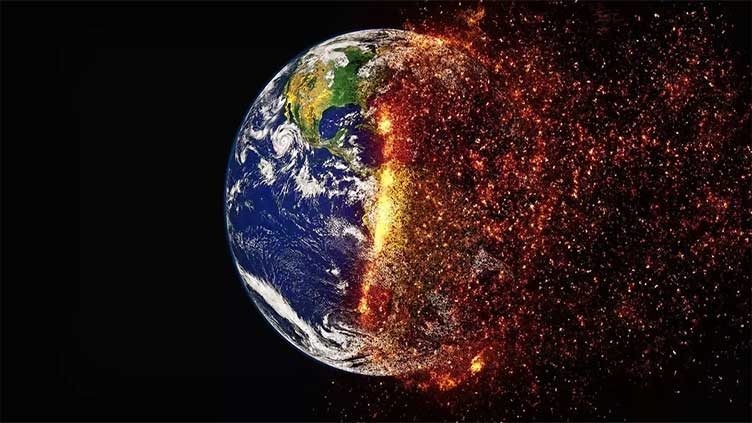
Summary Unprecedented heat will likely cause mass extinction
(Web Desk) - A supercomputer has predicted when Earth will become uninhabitable for humans.
In a new study by researchers at the University of Bristol, researchers ran supercomputer simulations to predict what’s in store for Earth.
The results showed that extreme climates will increase dramatically when the continents eventually merge again into a supercontinent called Pangea Ultima. It’s predicted to be extremely hot and dry and not a very habitable place.
There will likely be more frequent volcanic eruptions, large amounts of carbon dioxide, as well as the effect of global warming.
Unprecedented heat will likely cause mass extinction, according to their model, with the extremely high temperatures likely wiping out humans and mammals in 250 million years.
Lead author, Dr Alexander Farnsworth, Senior Research Associate at the University of Bristol, said: “The newly-emerged supercontinent would effectively create a triple whammy, comprising the continentality effect, hotter Sun and more CO2 in the atmosphere, of increasing heat for much of the planet. The result is a mostly hostile environment devoid of food and water sources for mammals."
Farnsworth added: “Widespread temperatures of between 40 to 50 degrees Celsius, and even greater daily extremes, compounded by high humidity levels, would ultimately seal our fate.
Humans and many other species would expire due to their inability to shed this heat through sweat, cooling their bodies.”
And Dr. Eunice Lo, Research Fellow in Climate Change and Health at the University of Bristol, warned: “It is critical not to lose focus on our current Climate Crisis, which stems from human emissions of greenhouse gases.
Although we foresee an uninhabitable planet in 250 million years, we have already witnessed extreme heat that adversely impacts human health. This underscores the urgency of achieving net-zero emissions as soon as possible.”