Jupiter-bound spacecraft set for key maneuver
Dunya News

A NASA spacecraft is prepared to fire its engine, a maneuver intended to bring it back toward Earth.

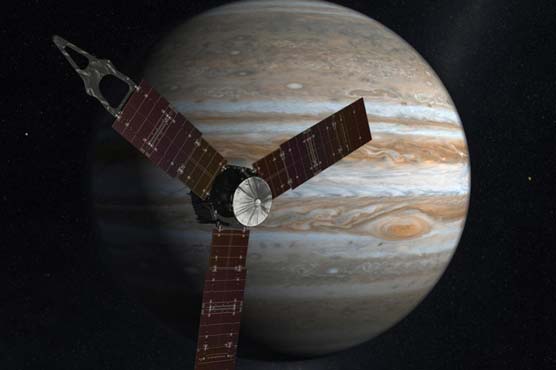
A Jupiter-bound spacecraft prepared to fire its engine Thursday for an important maneuver intended to bring it back toward Earth.The engine burn was the first of two planned to set up NASAs Juno spacecraft to use Earths gravity to accelerate it toward the outer solar system. The second engine firing will occur next week.Launched last year, Juno is zooming toward an encounter with the giant gas planet in 2016.More than half a dozen spacecraft have visited the solar systems largest planet since the 1970s, but Juno promises to venture closer for a deeper study into Jupiters evolution.By peering through Jupiters dense clouds and mapping its magnetic and gravity fields, scientists hope to better understand how the solar system formed.The $1.1 billion mission is managed by NASAs Jet Propulsion Laboratory.Juno is about 300 million miles (482 million kilometers) from Earth. Soon after launch, it glanced back and snapped a rare picture of Earth and the moon.Since the rocket that carried Juno was not powerful enough to boost it directly to its destination, it has to cruise out to space and swing back next year to use the Earth as a slingshot to push it toward Jupiter.The back-to-back burns were needed to put Juno on course to fly by Earth at an altitude of some 300 miles (482 million kilometers).To prepare for Thursdays engine burn, the spacecrafts fuel tanks were pressurized and its batteries were fully charged.Once in orbit around Jupiter, Juno will circle the poles 33 times and use instruments to track the abundance of water and oxygen in the atmosphere, and determine whether the planets core is solid or gaseous.Juno is the first solar-powered spacecraft to venture so far from the sun. It is equipped with three solar panels, each the size of a tractor-trailer.Juno is designed to study Jupiter for a year and then deliberately crash into the planet so that it wont pose any threat of biological contamination to moons such as Europa, which scientists believe may have a liquid ocean beneath its surface.