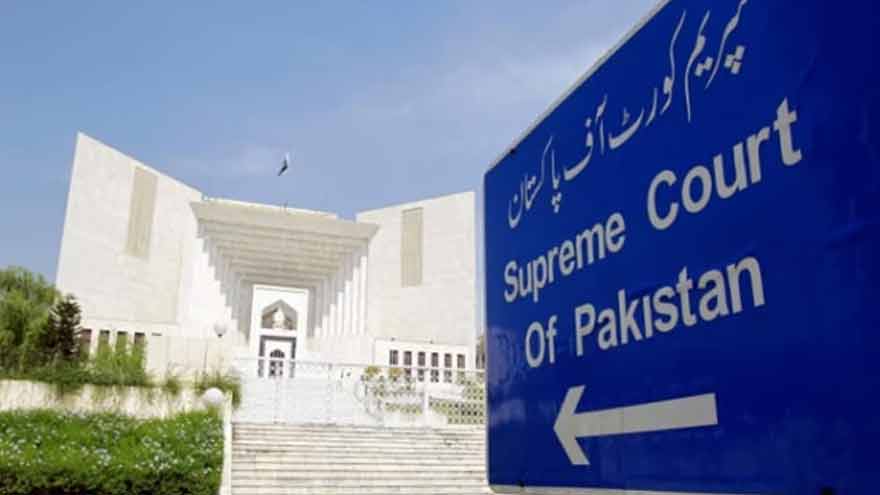
Summary Supreme Court upheld life imprisonment for Waris Masih in wife’s murder case, stressing women’s constitutional rights and ruling men are protectors, not perpetrators of violence
ISLAMABAD (Dunya News) — The Supreme Court of Pakistan has dismissed the appeal of Waris Masih, a drug addict convicted of murdering his wife, and upheld the decision of the Islamabad High Court to convert his death sentence into life imprisonment.
A three-member bench comprising Justice Muhammad Hashim Khan Kakar, Justice Salahuddin Panhwar and Justice Ishtiaq Ibrahim issued a detailed written judgment authored by Justice Kakar.
In its ruling, the apex court observed that men are protectors of women, not their killers. It emphasized that women are equal members of society and are entitled to protection, respect and dignity.
The judgment noted with concern that women in society are often subjected to brutal violence over trivial matters, describing such treatment as inhumane and barbaric.
The court highlighted drug addiction as one of the major causes behind the rising incidents of violence against women.
It categorically stated that no one can be allowed to defile the sanctity of sacred relationships such as mother, sister, wife and daughter.
The court further ruled that the state must curb violence against women through comprehensive legislation, effective enforcement mechanisms and supportive programs.
It declared that the protection of women is a constitutional obligation of the state under Article 9, which guarantees the right to life and liberty, and Article 25, which ensures equality before the law.
According to the prosecution, the convict was addicted to drugs and frequently quarreled with his wife. On the midnight of July 6, 2015, he attacked his wife and two minor children with sticks, inflicting severe injuries.
The couple’s daughter testified against her father as an eyewitness and injured witness. The medical report confirmed that the victim died due to a fractured skull and severe brain injuries.
The court observed that when a wife is killed inside her home, the primary responsibility to explain the circumstances lies with the husband. However, the accused remained silent during the trial and failed to provide any reasonable explanation for his wife’s unnatural death.
The judgment also noted that the accused absconded after the incident, did not attend the funeral and failed to inform the police factors considered strong incriminating evidence against him.
It is noteworthy that the trial court had originally sentenced Waris Masih to death for the murder of his wife, along with one year of rigorous imprisonment and a fine equivalent to five percent of the Diyat amount for injuring his children.
The Islamabad High Court later commuted the death penalty to life imprisonment, a decision that has now been upheld by the Supreme Court while dismissing the convict’s appeal.