


Syria economically devastated
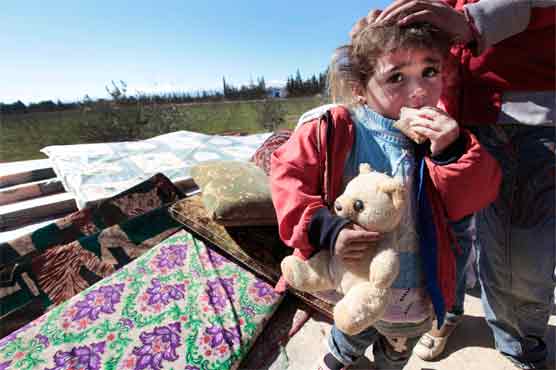
Government will be unable to pay wages after 2013, millions pushed into absolute poverty.
BEIRUT (Reuters) - Economic devastation is tearing Syria apart, perhaps irreparably if fighting rages for another two years, according to a former minister now working on a UN -backed reconstruction plan.
Abdallah al-Dardari said the damage wrought by the violence will already cost up to $80 billion, an impossible bill for a government which will soon be unable to pay state wages, let alone fund a nationwide programme of rebuilding.
As millions of Syrians are driven deeper into poverty and the ability of President Bashar al-Assad s authorities to provide basic services erodes, the forces pushing Syria towards disintegration will grow stronger, he said.
"Economics alone can fragment Syria if we go on like this," said Dardari, who served as Assad s deputy prime minister for economic affairs for six years until shortly after the uprising against the president erupted in March 2011.
Now working as an economist at the United Nations in Beirut, he heads a team devising a post-conflict plan - trying to bring Syrians from all sides of the crisis together to chart an inclusive political, economic and social reconstruction agenda.
"If this conflict stops today, we can still save the country and its economy, its society, its unity and sovereignty," Dardari told Reuters at his office in the U.N. Economic and Social Commission for Western Asia in the Lebanese capital.
Describing what he called a "very grim" economic picture, he said the economy shrank 35 to 40 percent in the last two years and unemployment soared to 33 percent from 8.3 percent.
Pre-conflict "strategic assets" including large foreign reserves, a positive balance of payments, low domestic and foreign debt, a budget deficit of just 1.7 percent of GDP and a healthy non-oil trade balance had "almost evaporated", he said.
"The government will not be able to finance its recurrent expenditures in full if the conflict continues beyond 2013," Dardari said. "I m talking about salaries and wages mainly."
If the war lasts into 2015, unemployment would reach 58 percent, probably with no jobs for young people, and the number of Syrians living in absolute poverty, on less than $1.25 a day, would rise to 44 percent from 12 percent before the crisis.
"Mali has a poverty line of 44 percent, so when (U.N. peace envoy Lakhdar) Brahimi talks about the Somalia-isation of Syria he is not exaggerating," Dardari said. "This is fertile ground for fundamentalism, extremism and the splintering of society."
The United Nations says 70,000 people have been killed in the increasingly sectarian fighting that has reduced entire districts of Syria s main cities to ruins.
"Despite the tremendous destruction, we are still at a crossroads," Dardari said, adding that if the conflict stopped now it would be possible to rebuild the country with acceptable levels of foreign and domestic debt.
Growing disparities between the wealthy beneficiaries of Assad s economic reforms and the millions of rural poor were one of the factors behind the unrest, and Dardari said that even without the violence Syria would have needed $90 billion to address its pre-crisis "developmental challenges".
The former minister and journalist, who studied economics and international relations in London and California, says he is trying to bring together Syrians from across the many political and sectarian divides to map out a plan for Syria s future.
They aim to produce a "National Agenda for the Future of Syria" by January, covering plans for economic recovery, social reconciliation and laying foundations of good governance.
The goal is ambitious, given that Assad, his political opponents and the armed rebels have shown little inclination to negotiate - despite recent hints of readiness for talks.
Taking a neutral position on the conflict itself, Dardari said it was important that both the government and the opposition consider the economic catastrophe facing Syria.
"We are not trying to impose our will. We are offering choices," he said. "Our role is to say clearly to all the belligerents and their backers - here are the facts."
"You cannot be oblivious to these facts. You cannot bury your head in the sand and say: Let s achieve our strategic targets in this conflict first and then see how we can rebuild Syria. I m not sure there will be a Syria to rebuild by 2015."
