Summary Hungary votes in a high-stakes election that could end Orban's 16-year rule, with opposition Tisza leading amid economic strain, corruption claims and EU Russia tensions now rise.
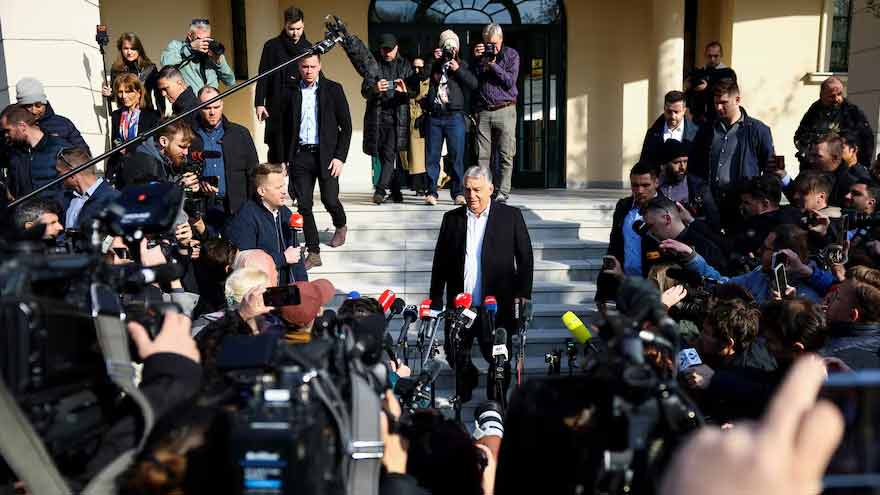
(Reuters) - Hungarians started voting on Sunday in an election that could end Prime Minister Viktor Orban's 16-year hold on power, rattle Russia and send shockwaves through right-wing circles across the West, including U.S. President Donald Trump's White House.
Orban, a eurosceptic nationalist, has carved out a model of an "illiberal democracy" seen as a blueprint by Trump's Make America Great Again (MAGA) movement and its admirers in Europe.
But many Hungarians have grown increasingly weary of Orban, 62, after three years of economic stagnation and soaring living costs, as well as reports of oligarchs close to the government amassing more wealth.
Opinion polls have shown Orban's Fidesz party trailing Peter Magyar's upstart centre-right opposition Tisza party by 7-9 percentage points, with Tisza at around 38-41%.
Voting in the election for the 199-seat parliament started at 6 a.m. local time (0400 GMT) and is due to close at 7 p.m.
VOTE COULD BRING RECORD TURNOUT, POLLSTERS SAY
"I think we need change in the country. We need an improvement in public mood, we are full of tensions in many areas and the current government only fuels these sentiments," said Mihaly Bacsi, 27, after casting his vote for Tisza in a Budapest polling station.
Pollsters said the election could bring record turnout.
"It would be important to return to our Western commitment, this is where Fidesz also started a long time ago and it could be that we will return to the Western path without (Fidesz)."
The vote is being closely watched in Brussels, with many EU peers criticising Orban, a friend of Russian President Vladimir Putin and a close Trump ally, over what they say is an erosion of Hungary's democratic rule, media freedom and minority rights.
For Hungary's eastern neighbour Ukraine, an Orban defeat could mean the unblocking of a 90-billion-euro ($105 billion) European Union loan vital for Kyiv's war effort. It would also deprive Russia of its closest ally in the EU.
Orban has cast the election as a choice between "war and peace". During campaigning, the government blanketed the country with signs warning that Tisza leader Magyar would drag Hungary into Russia's war with Ukraine, something he strongly denies.
"I am looking forward to Sunday's election with the best hope," Orban told supporters in his birthplace Szekesfehervar.
"If we know ourselves well, if we know our country well and if we know our own people well, then I must say Hungarians will vote for safety on Sunday," he added.
PUBLIC DISCONTENT
Orban has won public endorsements from the Trump administration - culminating in a visit to Budapest by Vice President JD Vance last week - as well as from the Kremlin and far-right leaders in Europe.
But his campaign has been shaken by media reports alleging that his government colluded with Moscow. Orban, who denies any wrongdoing, says his goal is to protect Hungary's national identity and traditional Christian values within the EU and its security in a dangerous world.
Meanwhile, former Orban loyalist Magyar, 45, has tapped into discontent over alleged state corruption and falling living standards, with young voters particularly eager for change.
"I am very excited but also very scared," said Kriszta Tokes, a 24-year-old who sells postcards and trinkets in Budapest. "I know that my future depends on this," she said, adding that she plans to leave Hungary if Orban wins.
While Orban's party has done good things "on paper," Tokes said, referring to massive fiscal handouts he has provided to shore up support, she believed young people were struggling more than the government realised.
ORBAN'S LOW POPULARITY AMONG UNDER-30s
To address a popularity rating of just 8% among under-30s, Orban has scrapped income tax for the youngest workers and launched a subsidised mortgage scheme to help first-time buyers onto the housing ladder amid the EU's steepest rise in house prices under his rule.
But Magyar's offer of change appears to resonate more.
In a final push in the eastern town of Miskolc on Friday, Magyar said: "This will be a referendum... about our country's place and our country's future."
Analysts caution that the outcome of the vote remains uncertain, with many undecided voters, a redrawing of the electoral map in favour of Fidesz and a high proportion of ethnic Hungarians in neighbouring countries, who mostly support the ruling party.
They say anything from a Tisza supermajority - able to change the constitution - to a Fidesz majority is possible.
If Tisza does win, unwinding the legal and institutional changes Orban has made may prove a daunting task for a new government if it has a simple majority in parliament.