Summary An Israeli government official said the visit would "pave the way for new partnerships and collaborations across many fields.
JERUSALEM (Reuters) - India's Prime Minister Narendra Modi arrives in Israel on Wednesday for a two-day visit that both countries have cast as a chance to deepen relations, as regional concerns mount over the risk of military conflict between the United States and Iran.
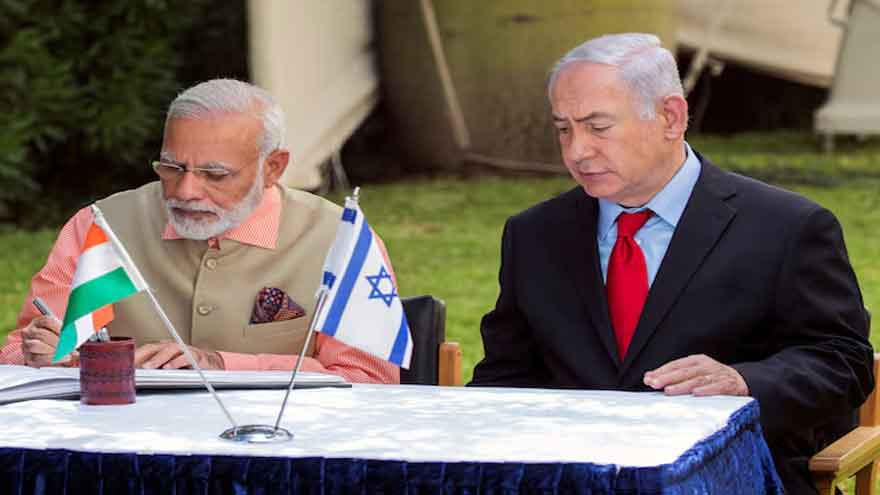
Modi, a Hindu nationalist, became the first prime minister in India's history to visit Israel in 2017, during which he and right-wing Prime Minister Benjamin Netanyahu took a barefoot stroll on a beach in the northern port city of Haifa.
Both still in power nearly nine years later, the two leaders, who describe one another as friends, are expected to hold talks on artificial intelligence as well as defence at a time when Israel is seeking to increase its military exports.
An Israeli government official said the visit would "pave the way for new partnerships and collaborations across many fields." Bilateral ties were on the cusp of a significant upgrade, an Israeli foreign ministry official said.
Modi is expected to deliver remarks to Israel's Knesset, or parliament, and lay a wreath at Yad Vashem, Israel's official Holocaust memorial.
US MILITARY BUILDUP NEAR IRAN
Modi's visit comes as the United States deploys a vast naval force near Iran's coast ahead of possible strikes on the Islamic Republic, with the two countries at an impasse in talks over Tehran's nuclear programme. The Pentagon has also deployed an aircraft carrier to the Mediterranean, bound for Israel's coast.
A US attack on Iran could draw Iranian retaliation targeting Israel as well as U.S. military facilities in Gulf Arab countries, where millions of Indians live and work and send home billions of dollars of remittances each year.
Kabir Taneja, of the Observer Research Foundation, an Indian think-tank, said that New Delhi did not want to see conflict in the region.
"I'm sure those kind of messages have been delivered in the past and will be delivered during this visit as well," he said.
The Israeli foreign ministry official said discussions with a "regional aspect" would likely take place during the visit.
Speaking at a cabinet meeting this week, Netanyahu described India as being part of a future "axis" of like-minded nations that see eye-to-eye in confronting "the radical Shi'ite axis" and "the emerging radical Sunni axis". Iran has a Shi'ite Muslim theocracy.
"(Our) cooperation can yield great results and, of course, ensure our resilience and our future," Netanyahu said.
Taneja said that, while India was interested in buying Israeli military equipment, New Delhi would hesitate at joining any formal alliance given its history of non-alignment in international affairs.