Summary Factbox: Russia's nuclear arsenal: how big is it and who controls it?
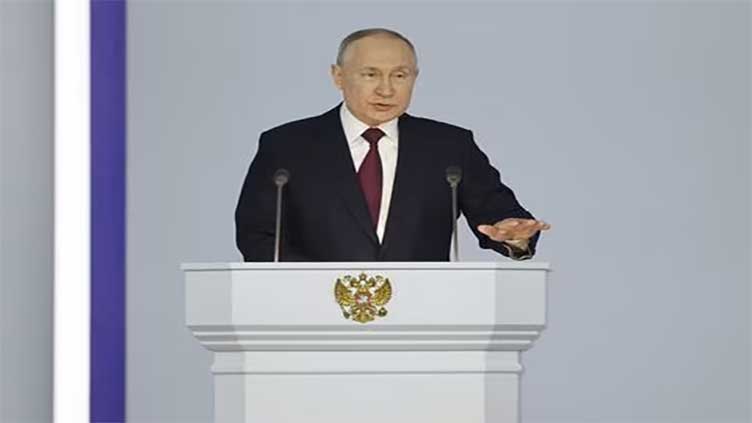
MOSCOW (Reuters) - President Vladimir Putin said on Saturday that Russia has struck a deal with neighbouring Belarus to station tactical nuclear weapons on its territory but will not violate non-proliferation agreements. The following are details of Russia's nuclear arsenal, how big it is and who commands it.
NUCLEAR SUPERPOWER
Russia, which inherited the Soviet Union's nuclear weapons, has the world's biggest store of nuclear warheads.
Putin controls around 5,977 such warheads as of 2022, compared to 5,428 controlled by U.S. President Joe Biden, according to the Federation of American Scientists.
Around 1,500 of those warheads are retired (but probably still intact), 2889 are in reserve and around 1588 are deployed strategic warheads.
About 812 are deployed on land-based ballistic missiles, about 576 on submarine-launched ballistic missiles, and around 200 at heavy bomber bases, according to the Bulletin of the Atomic Scientists.
The United States has around 1644 deployed strategic nuclear warheads. China has a total of 350 warheads, France 290 and the United Kingdom 225, according to the Federation of American Scientists.
Such numbers mean that both Moscow and Washington could destroy the world many times over.
During the Cold War, the Soviet Union had a peak of around 40,000 nuclear warheads, while the U.S. peak was around 30,000 warheads.
The key, though, is how to deliver the weapon - the missiles, submarines and bombers that carry the warhead.
Russia appears to have about 400 nuclear-armed intercontinental ballistic missiles, which the Bulletin of the Atomic Scientists estimate can carry up to 1,185 warheads.
Russia operates 10 nuclear-armed nuclear submarines which could carry a maximum of 800 warheads. It has around 60 to 70 nuclear bombers.
NEWER NUKES
The United States said in its 2022 Nuclear Posture Review that Russia and China were expanding and modernising their nuclear forces, and that Washington would pursue an approach based on arms control to head off costly arms races.
Putin said he had information that the United States was developing new types of nuclear weapons.
Russia has been modernising its nuclear weapons.
Since the Soviet Union collapsed in 1991, only a few countries have tested nuclear weapons, according to the Arms Control Association: The United States last in 1992, China and France last in 1996, India and Pakistan in 1998, and North Korea last in 2017.
The Soviet Union last tested in 1990