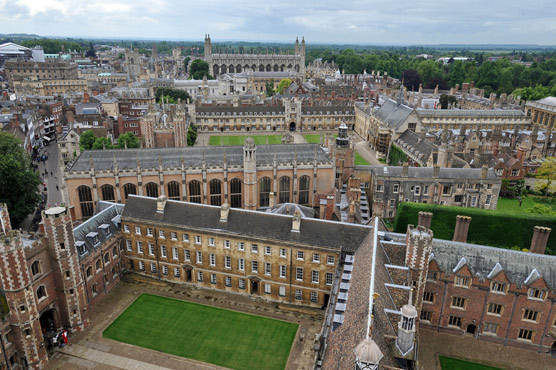
Summary CUP has stated that the publishers are committed to freedom of thought and expression.Photo:Guardian
(Web Desk) – Cambridge University Press, one of the most respectable and oldest publishing houses has come under fire by academics throughout the world for bowing down to China’s demands of censorship.The press has been accused for agreeing to eliminate politically sensitive articles from its Chinese website.
According to the Guardian, the publishing house has blocked access to the readers from hundreds of academic articles. Cambridge University Press (CUP) argued that it had to comply with the request from the Chinese authorities, to avoid its other publications from getting barred.
The official website of CUP confirmed the eliminated list of blocked articles that were removed from the China Quarterly, from within China. China Quarterly is one of the respectable study journals covering all aspects of contemporary China.
“We can confirm that we received an instruction from a Chinese import agency to block individual articles from China Quarterly from within China,” CUP said. “We complied with this initial request to remove individual articles, to ensure that other academic and educational material we publish remains available to researchers and educators in this market.”
Message from the Editor regarding censorship concerns. The list of blocked articles and book reviews will be available on the CUP site soon. pic.twitter.com/wC3p8AuJKZ
— The China Quarterly (@chinaquarterly) August 18, 2017
The 1989 Tiananmen massacre, Mao Zedong’s catastrophic Cultural Revolution, Hong Kong’s fight for democracy and ethnic tensions in Xinjiang and Tibet were among the blocked list of scholarly articles.
Many blocked articles were written by some of the world’s top China specialists, including Columbia University’s Andrew Nathan, George Washington University’s David Shambaugh and Harvard University scholars Roderick MacFarquhar and Ezra Vogel.
Despite the censorship CUP has stated that the publishers are committed to freedom of thought and expression and are “troubled by the recent increase in requests of this nature” from China. The publishing house has vowed to raise the issue with relevant agencies.
There was an outcry by academics and activists who took on social media sites to call for the decision to be reversed.
A letter to @CambridgeUP on censoring @chinaquarterly in China, with @jessicacweiss: pic.twitter.com/hllvWbY353
— Greg Distelhorst (@gregdistelhorst) August 18, 2017
“Pragmatic is one word, pathetic more apt,” tweeted Rory Medcalf, the head of the national security college at the Australian National University.
Cambridge University Press limits access to articles in China - pragmatic is one word, pathetic more apt https://t.co/tyhGc4LZ7k
— Rory Medcalf (@Rory_Medcalf) August 18, 2017
Renee Xia, the international director of the Chinese Human Rights Defenders network wrote on her Twitter that, “CUP sold its soul for millions of Chinese govt dollars.”
.@Cambridge_Uni sold its soul for millions of Chinese govt dollars. https://t.co/rquXDBpqtH
— Renee Xia(@ReneeXiaCHRD) August 18, 2017
Nathan, the editor of a seminal work on the Tiananmen crackdown, added: “I imagine [CUP] might argue that it was serving a higher purpose, by compromising in order to maintain the access by Chinese scholars to most of the material it has published. This is similar to the argument by authors who allow Chinese translations of their work to be censored so that the work can reach the Chinese audience. [But] that’s an argument I have never agreed with.”
“Of course, there may also be a financial motive, similar to Bloomberg, Facebook, and others who have censored their product to maintain access to the Chinese market. This is a dilemma, but if the West doesn’t stand up for its values, then the Chinese authorities will impose their values on us. It’s not worth it.”
Foreign academic presses exempted already existing censorship in China which included foreign news organisations, social media sites which includes Facebook, Twitter and YouTube. Google is also blocked from the access of local Chinese internet users. Apart from the blockage of CUP’s articles, China has also blocked JSTOR certain links on site. JSTOR is a digital library that is used by academics around the world.