Summary European leaders re-elected Donald Tusk as EU president at a Brussels summit on Thursday.
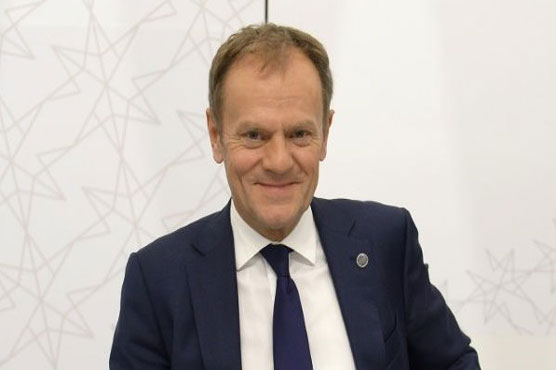
BRUSSELS (AFP) - Once a self-confessed football "hooligan", Poland s Donald Tusk handily won his fight with his own country to remain European Council president.
The 59-year-old former Polish premier again took the top Brussels job he first snagged in 2014, symbolising the former Soviet-ruled east s rise to the heart of the new Europe.
A native of the port city of Gdansk where the Solidarity anti-communist trade union was born, he had to learn English from scratch when he took up the EU post.
His learning curve in the job was equally steep but he has gradually won over EU leaders for his handling of crises ranging from migration to Greece s economic plight to Britain s vote to leave the EU.
Tusk s job in a second term as head of the European Council, which brings together the EU leaders, will be to maintain unity as they prepare for tough Brexit negotiations.
Ironically his own candidacy proved a fresh cause for disunity, as Poland s right-wing government desperately tried to block him, even if it ended up alone in the effort.
"Be careful of the bridges you burn because once they are gone you can never cross them again," Tusk told a summit press conference.
EU leaders were alarmed at the fact that his bitter enmity with Poland s ruling Law and Justice party during his seven years as premier had finally spilled onto the international stage.
Angela Merkel, the German chancellor and Europe s most powerful leader, said before the vote it would be a "sign of stability" if he was re-elected.
With his direct manner and piercing blue eyes, Tusk was a contrast to his haiku-writing, consensus-building Belgian predecessor Herman Van Rompuy when he took office two and a half years ago.
But he initially seemed unwilling to get his hands dirty.
"In the first year you could realise how difficult it was for him. He did not really want to get involved in the Greek crisis," analyst Janis Emmanouilidis told AFP.
"But eventually he had to take things in his hands. At the Euro summit in July 2015 he forced all sides to find a compromise and participated to prevent the worst."
Since then, Tusk has won a reputation for plain speaking with a penchant for colourful and sometimes apocalyptic warnings about the existential crisis that Europe faces.
Of Brexit, he warned for example that "there will be no cakes on the table for anyone, there will be only salt and vinegar."
He has since taken a tough stance on Russia in particular, and also on migration, arguing for tougher control of the EU s borders.
"In the refugee crisis he supported very fast the security faction and not the solidarity camp led by Chancellor Merkel. That annoyed Merkel," Emmanouilidis said.
"But in the end Tusk backed the right horse, because Merkel had to recalibrate her policy."
Tusk s roots as a fighter go back to his upbringing in Gdansk on the Baltic Sea.
"As a child, as a young man, I was a typical hooligan... We would roam the streets, you know, cruising for a bruising" after fights or football matches, he told the Financial Times in 2014.
Football has continued to be an obsession, with Tusk able to recite football results from major tournaments held decades ago off the top of his head.
Gdansk later became the cradle of the Solidarity movement and it was here that Tusk forged his credentials as something of a Cold War warrior.
First a trade unionist and journalist and historian, he became involved in liberal politics.
He took power in 2007 from the ultra-conservative Kaczynski twins, serving until he left for Brussels in 2014.
He is married to historian Malgorzata Tusk and has two adult children, one of whom is a well-known fashion blogger in Poland.
But Tusk remains a hate figure for the Law and Justice party that the Kaczynskis founded, and from which Prime Minister Beata Szydlo hails.
Jaroslaw Kaczynski remains a bitter enemy, accusing then premier Tusk of having "moral responsibility" for the death of his brother Lech, the then-president, in an air crash in Russia in 2010.