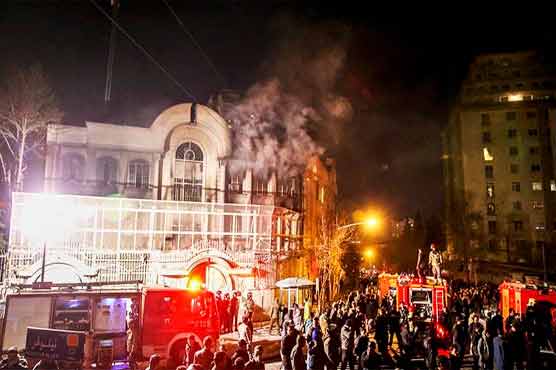
Summary Demonstrators had massed at the embassy gates to protest at Nimr al-Nimr's execution.
DUBAI (Reuters) - Iranian protesters stormed the Saudi Embassy in Tehran early on Sunday morning as the country reacted with fury to Saudi Arabia s execution of a prominent Shia cleric.
Demonstrators who had massed at the embassy gates to protest at Nimr al-Nimr s execution broke into the embassy and started fires before being cleared away by the police, Iran s IRNA news agency reported.
Pictures were tweeted that showed parts of the interior on fire and smashed furniture inside one office.
Shortly afterwards, Iran s Foreign Ministry issued a statement calling for calm and urging protesters to respect the diplomatic premises, the Entekhab news website reported.
Iran s hardline Revolutionary Guards had promised "harsh revenge" against the Saudi royal dynasty for Saturday s execution of Nimr who is considered a terrorist by Riyadh but hailed in Iran as a champion of the rights of Saudi Arabia s Shia minority.
Nimr, the most vocal critic of the dynasty among the Shia minority, had come to be seen as a leader of the sect s younger activists.
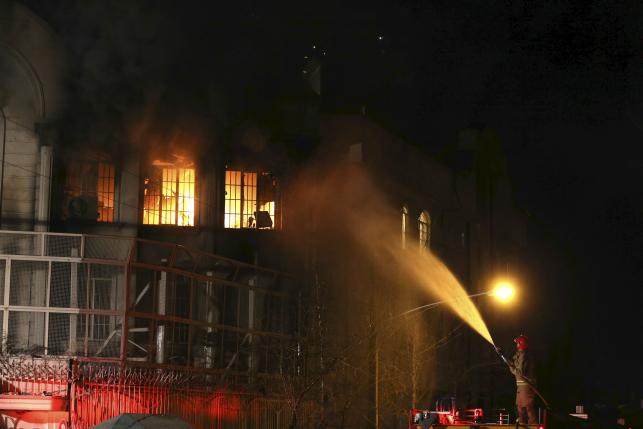
Flames rise from Saudi Arabia s embassy during a demonstration in Tehran January 2, 2016
Although most of the 47 men killed in the kingdom s biggest mass execution for decades were Sunnis convicted of Al Qaeda attacks in Saudi Arabia a decade ago, it was Nimr and three other Shias, all accused of involvement in shooting police, who attracted most attention in the region and beyond.
The move appeared to end any hopes that the appearance of a common enemy in the form of the militant Islamic State (IS) group would produce some rapprochement between the region s leading Sunni and Shia Muslim powers, who back opposing sides in wars currently raging in Syria and Yemen.
The website of Iran s Supreme Leader, Ayatollah Ali Khamenei, carried a picture of a Saudi executioner next to notorious IS executioner Jihadi John , with the caption “Any differences?”, and Iran s powerful Revolutionary Guards said “harsh revenge” would topple “this pro-terrorist, anti-Islamic regime”.
Saudi Arabia summoned the Iranian ambassador, only to see its embassy stormed soon afterwards.
Iraq also furious
In Iraq prominent religious and political figures demanded that ties with Riyadh be severed, calling into question Saudi attempts to forge a regional alliance against IS, which controls swathes of Iraq and Syria.
Despite the regional focus on Nimr, the executions seemed mostly aimed at discouraging militancy in Saudi Arabia, where dozens have died in the past year in attacks by militants.
The ruling Al Saud family has grown increasingly worried in recent years as Middle East turmoil, especially in Syria and Iraq, has boosted insurgents seeking to bring it down and given room to Iran to spread its influence.
A nuclear deal with Iran backed by Saudi Arabia s biggest ally and protector, the United States (US), has done little to calm nerves in Riyadh.
.jpg)
People protest in front of Saudi Arabia s embassy during a demonstration in Tehran January 2, 2016
But Saudi Arabia s Western allies, many of whom supply it with arms, are growing concerned about its new assertiveness in the region and at home.
The US State Department said Nimr s execution "risks exacerbating sectarian tensions at a time when they urgently need to be reduced". The sentiment was echoed almost verbatim by European Union foreign policy chief Federica Mogherini and an official at the German Foreign Ministry.
The State Department also urged the Saudi government to "respect and protect human rights, and to ensure fair and transparent judicial proceedings in all cases", as well as to permit peaceful expression of dissent and work with all community leaders to defuse tensions.
The simultaneous execution of 47 people �