Summary John Kerry expressed "cautious optimism" about defusing the Israeli-Palestinian violence.
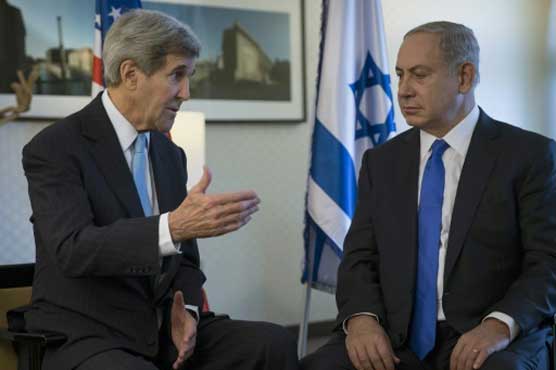
BERLIN (AFP) - US Secretary of State John Kerry on Thursday expressed "cautious optimism" about defusing the latest round of Israeli-Palestinian violence after four hours of talks in Berlin with Israel s Benjamin Netanyahu.
The two met as part of a flurry of diplomatic activity aimed at halting the cycle of violence, which erupted on October 1 and has raised fears of a new Palestinian intifada, or uprising.
Ahead of his talks with Kerry, the Israeli prime minister took a hard line, pointing the finger at Palestinian president Mahmud Abbas for inciting the wave of attacks.
But following the four-hour meeting, Kerry said he had "a cautious measure of optimism that there may be some things that could be, in the next couple of days, put on the table."
The aim was to encourage all parties "that there is a way to defuse the situation and begin a way forward," he said.
State department spokesman John Kirby said "constructive proposals" had been raised at the talks which included "steps Israel could take to reaffirm yet again the continued commitment to maintaining the status quo" at the flashpoint Al Aqsa mosque compound, which is known to Jews as the Temple Mount.
Kerry said he discussed several issues with Netanyahu which he would raise with Abbas and Jordan s King Abdullah II, who has previously played a key role in mediation between the two sides.
"If parties want to try -- and I believe they do want to move to a de-escalation -- I think there are sets of choices that are available," he said, expressing hope that "we can seize this moment and pull back from the precipice."
In the latest violence, two Palestinians attempted to board a bus carrying children in Beit Shemesh near Jerusalem, but were repelled by the driver and others. They then stabbed a passerby, moderately wounding him, before being shot. One of the assailants was killed and the other was critically wounded, police said.
Since October 1, at least 49 Palestinians and one Israeli Arab have been killed, including alleged attackers. Eight Israelis have been killed in attacks.
Alarmed by the wave of violence, UN chief Ban Ki-moon made a surprise visit to the region this week to meet with both sides, but said on Wednesday he was "not optimistic" about finding ways to calm the situation.
On Thursday, he met Abdullah in Amman where he stressed "the responsibility of Arab leaders to encourage calm and to ensure that this crisis does not get out of control".
Meanwhile in Berlin, Netanyahu met separately with German Foreign Minister Frank-Walter Steinmeier and the EU foreign police chief Federica Mogherini.
And representatives of the Middle East Peace Quartet, which comprises diplomats from the UN, the EU, the US and Russia, are to meet over the situation in Vienna on Friday, said Mogherini.
Netanyahu has repeatedly accused Abbas of fanning the flames and has rejecting allegations Israel has used excessive force in separate talks with both Ban and Chancellor Angela Merkel.
"There is no question that this wave of attacks was driven directly by the incitement, the incitement of Hamas, the incitement of the Islamist movement in Israel and the incitement, I am sorry to say, from president Abbas and the Palestinian Authority," he said.
"I think it is time for the international community to say clearly to president Abbas: stop spreading lies about the state of Israel," added Netanyahu.
Earlier this week, the Israeli leader himself stirred controversy by claiming it was a Palestinian religious leader, the Grand Mufti of Jerusalem, who gave Adolf Hitler the idea of exterminating the Jews.
But Merkel on Wednesday took pains to stress Germany s own culpability in the Holocaust.
"Germany abides by its responsibility for the Holocaust," she said at a joint press conference with Netanyahu.
Speaking to the Security Council by videolink on Wednesday, Ban delivered a sobering assessment of prospects for a return to calm, saying there was no time to waste. Details of his update, which was presented behind closed doors, were relayed by a diplomat.
He also presented a report on international protection after the Palestinians called for the deployment of an observer force in occupied and annexed east Jerusalem.
Seen by AFP, the report outlines 17 cases -- from Trieste after World War II to Kosovo in 1999 -- when the Security Council stepped in and set up special regimes to guarantee the protection of civilians.
After meeting Ban on Thursday, Abdullah reiterated his warning to Israel against any move to change the status quo at the flashpoint Al-Aqsa mosque compound in Jerusalem s Old City.
Clashes there between Israeli security forces and Palestinian protesters triggered the latest round of violence.
Netanyahu has repeatedly accused Abbas of incitement by suggesting Israel wants to change the status quo at the compound, which is sacred to both Muslims and Jews.
The Israeli leader has insisted he has no intention of changing the rules.