Summary Militants in the Sinai have killed scores of policemen and soldiers since Morsi's overthrow.
CAIRO (AFP) - Human Rights Watch on Tuesday accused Egypt s military of having "violated international law" through mass home demolitions and evictions over the past two years along its border with Gaza.
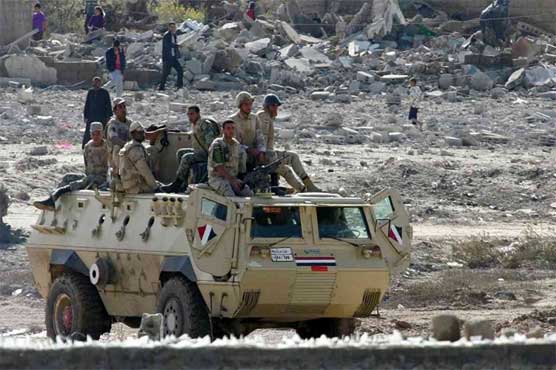
Egypt s army in October created a wide buffer zone in the border town of Rafah in the north of the Sinai peninsula, where it says tunnels have allowed militants and weapons in from the Palestinian enclave.
"The large-scale destruction of at least 3,255 buildings in Rafah to counter the threat of smuggling tunnels was likely disproportionate and did not meet Egypt s obligations under international human rights law or the laws of war," HRW said.
Since July 2013, "the military has arbitrarily razed thousands of homes in a once-populated buffer zone on the border with the Gaza Strip, destroying entire neighbourhoods and hundreds of hectares (acres) of farmland," the New York-based rights watchdog said.
Egypt has stepped up its battle against militants -- including Egypt s branch of the Islamic State group Sinai Province -- since then army chief Abdel Fattah al-Sisi ousted elected Islamist president Mohamed Morsi in July 2013.
Militants in the Sinai have killed scores of policemen and soldiers since Morsi s overthrow, vowing revenge against a crackdown on his supporters that has killed more than 1,400 people and jailed thousands.
"Destroying homes, neighbourhoods, and livelihoods is a textbook example of how to lose a counterinsurgency campaign," said Sarah Leah Whitson, HRW head for the Middle East and North Africa.
The Egyptian government has failed to provide adequately for about 3,200 families during and after their eviction from their homes, HRW said.
"The Egyptian authorities provided residents with little or no warning of the evictions, no temporary housing, mostly inadequate compensation for their destroyed homes," read the report.
When it started work on the buffer zone in October,Egypt said those whose homes were demolished would receive compensation.
Egypt s official plan for the buffer zone calls for clearing about 79 square kilometres (30 square miles) on the Gaza border, including all of Rafah, a town of about 78,000 people, HRW said.
The rights group compiled its 84-page report from interviews with 11 evicted families, journalists and activists in Sinai, and satellite images of the buffer zone between March 2013 and August 2015.
"Though Egyptian military officials -- and occasionally their Israeli counterparts -- have alleged that armed groups in the Sinai use the tunnels to receive weapons and logistical support from Gaza, they have not provided proof," it said.
Egypt in 1979 became the first Arab country to sign a peace treaty with Israel.
- Training from US army -
"The Egyptian army has failed to explain why it cannot use... non-destructive means for detecting and neutralising tunnels," it said, adding that its troops have reportedly received training for this from the US army since 2008.
"The United States and other Western nations that arm al-Sisi s government look the other way when his forces abuse citizens under the dubious logic that he is aiding the fight against the Islamic State," Whitson said.
"But al-Sisi s reckless counterinsurgency strategy serves mostly to turn his own citizens against their government," she said.
Amnesty International in November condemned Egypt s demolition of hundreds of homes and called for a halt to its "unlawful evictions" of residents to create the buffer zone.