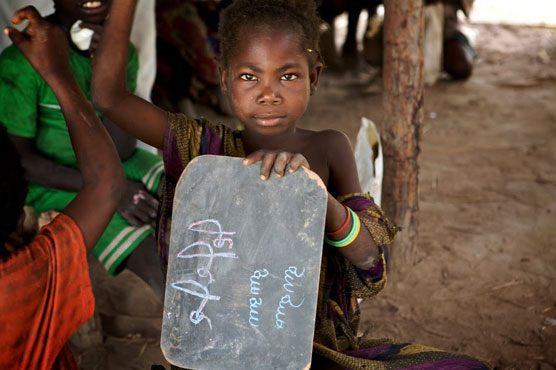
Summary Watch list highlighted numerous cases in which schools were looted and terrorized by armed groups
UNITED NATIONS (AFP) - The Central African Republic must act to protect schools from militia attacks and forbid their use for military purposes, a non-governmental group that monitors the impact of conflict on children said Thursday.
The Watchlist on Children and Armed Conflict highlighted numerous cases in which the country s schools have been looted and students and teachers terrorized by armed groups.
CAR descended into bloodshed after a 2013 coup against longtime leader Francois Bozize and remains prey to sectarian conflict between Muslim Seleka rebels and Christian anti-balaka militias despite the presence of UN and African Union peacekeepers.
The group said in a report that 30 percent of the country s 335 schools have been attacked since 2012 and 8.4 percent were used as bases by armed groups and even international forces deployed to stabilize the country, notably the African Union-led force known as MISCA.
In February 2014, 65 percent of the country s schools were closed because of the lack of security, it said.
"Despite significant progress in reopening schools for the 2014-15 academic year, armed groups continue to impede children s right to education," the report said.
"Many students and teachers have returned to school for the 2014-2015 academic year, but remain vulnerable to attack," Janine Morna, a researcher for the group said. "Ensuring children s right to education is fundamental to CAR s transition to peace."
While between 78 and 88 percent of schools are officially open, attendance is intermittent and sparse because of the persistent threat of attack, she said, adding that the climate of insecurity makes it difficult to gather reliable statistics.
The government in June made commitments to protect schools but must still implement its own guidelines and criminalize attacks on school, she said
"Armed groups, the African Union, and the French government should similarly adopt and implement stronger policies that prohibit, or at least minimize, the military use of schools to protect children s right to education," said Morna.
The United Nations, which has a peacekeeping mission in CAR known as Minusca, has a policy against using schools to house its troops or their equipment.
The report was based on an on-the-ground survey and interviews with 178 teachers and students, mainly in Bangui.
One teacher quoted in the report described anti-balaka militias looting a school s food stocks for student meals.
"They came around 11 pm, shooting in the air before they came in," the teacher said. "They took all the food and left us only (a few) bags of rice."
"We work in an atmosphere of worry all the time. This is why students don t return," another teacher said. "We are not totally secure here (at school), anything can happen."